

2. CHITIN AND MUCOSUBSTANCES
111
2. Glycosidic Bonds of Chitin
The currently accepted view of chitin as an unbranched polymer of
2-acetamido-2-deoxy-D-glucopyranose linked in the ß-(l -> 4) positions is
based on three principal sources of evidence: (a) analysis and degradation of chitobiose; (h) characterization of oligosaccharides from chitin;
(c) X-ray diffraction analyses of chitin crystallites and the similarity of
the patterns with those of cellulose.
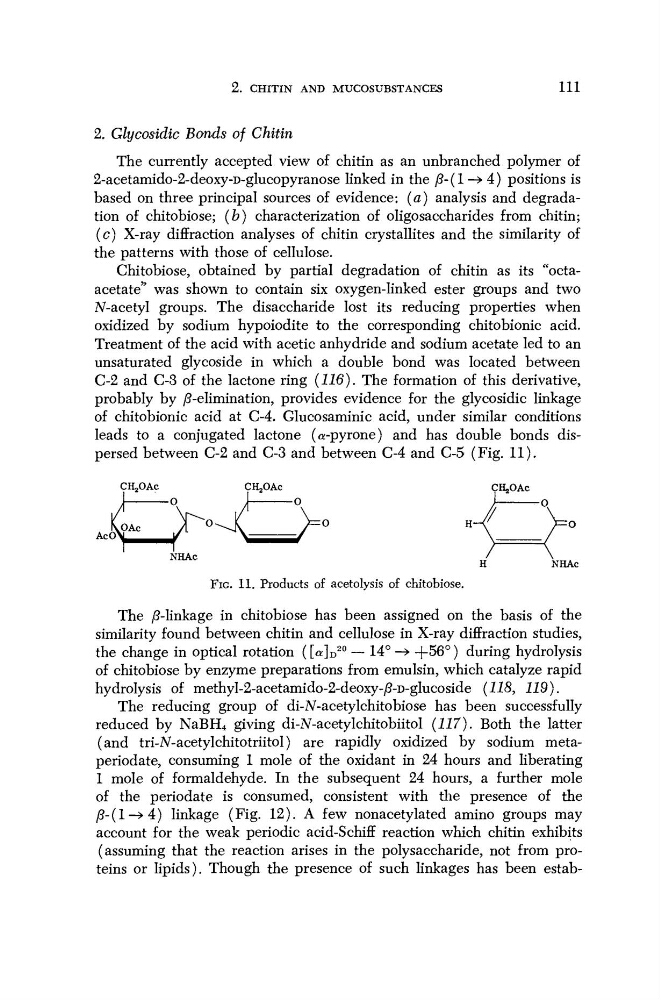
Chitobiose, obtained by partial degradation of chitin as its "octaacetate" was shown to contain six oxygen-linked ester groups and two
N-acetyl groups. The disaccharide lost its reducing properties when
oxidized by sodium hypoiodite to the corresponding chitobionic acid.
Treatment of the acid with acetic anhydride and sodium acetate led to an
unsaturated glycoside in which a double bond was located between
C-2 and C-3 of the lactone ring (116). The formation of this derivative,
probably by /^elimination, provides evidence for the glycosidic linkage
of chitobionic acid at C-4. Glucosaminic acid, under similar conditions
leads to a conjugated lactone (α-pyrone) and has double bonds dispersed between C-2 and C-3 and between C-4 and C-5 (Fig. 11).
FIG. 11. Products of acetolysis of chitobiose.
The /^linkage in chitobiose has been assigned on the basis of the
similarity found between chitin and cellulose in X-ray diffraction studies,
the change in optical rotation ([«]D
20 — 14° -> +56°) during hydrolysis
of chitobiose by enzyme preparations from emulsin, which catalyze rapid
hydrolysis of methyl-2-acetamido-2-deoxy-/3-D-glucoside (118, 119).
The reducing group of di-N-acetylchitobiose has been successfully
reduced by NaBH 4 giving di-N-acetylchitobiitol (117). Both the latter
(and tri-N-acetylchitotriitol) are rapidly oxidized by sodium metaperiodate, consuming 1 mole of the oxidant in 24 hours and liberating
1 mole of formaldehyde. In the subsequent 24 hours, a further mole
of the periodate is consumed, consistent with the presence of the
β-(1—»4)
linkage (Fig. 12). A few nonacetylated amino groups may
account for the weak periodic acid-Schiff reaction which chitin exhibits
(assuming that the reaction arises in the polysaccharide, not from proteins or lipids). Though the presence of such linkages has been estab-
111
2. Glycosidic Bonds of Chitin
The currently accepted view of chitin as an unbranched polymer of
2-acetamido-2-deoxy-D-glucopyranose linked in the ß-(l -> 4) positions is
based on three principal sources of evidence: (a) analysis and degradation of chitobiose; (h) characterization of oligosaccharides from chitin;
(c) X-ray diffraction analyses of chitin crystallites and the similarity of
the patterns with those of cellulose.
Chitobiose, obtained by partial degradation of chitin as its "octaacetate" was shown to contain six oxygen-linked ester groups and two
N-acetyl groups. The disaccharide lost its reducing properties when
oxidized by sodium hypoiodite to the corresponding chitobionic acid.
Treatment of the acid with acetic anhydride and sodium acetate led to an
unsaturated glycoside in which a double bond was located between
C-2 and C-3 of the lactone ring (116). The formation of this derivative,
probably by /^elimination, provides evidence for the glycosidic linkage
of chitobionic acid at C-4. Glucosaminic acid, under similar conditions
leads to a conjugated lactone (α-pyrone) and has double bonds dispersed between C-2 and C-3 and between C-4 and C-5 (Fig. 11).
FIG. 11. Products of acetolysis of chitobiose.
The /^linkage in chitobiose has been assigned on the basis of the
similarity found between chitin and cellulose in X-ray diffraction studies,
the change in optical rotation ([«]D
20 — 14° -> +56°) during hydrolysis
of chitobiose by enzyme preparations from emulsin, which catalyze rapid
hydrolysis of methyl-2-acetamido-2-deoxy-/3-D-glucoside (118, 119).
The reducing group of di-N-acetylchitobiose has been successfully
reduced by NaBH 4 giving di-N-acetylchitobiitol (117). Both the latter
(and tri-N-acetylchitotriitol) are rapidly oxidized by sodium metaperiodate, consuming 1 mole of the oxidant in 24 hours and liberating
1 mole of formaldehyde. In the subsequent 24 hours, a further mole
of the periodate is consumed, consistent with the presence of the
β-(1—»4)
linkage (Fig. 12). A few nonacetylated amino groups may
account for the weak periodic acid-Schiff reaction which chitin exhibits
(assuming that the reaction arises in the polysaccharide, not from proteins or lipids). Though the presence of such linkages has been estab-