

110
P. W. KENT
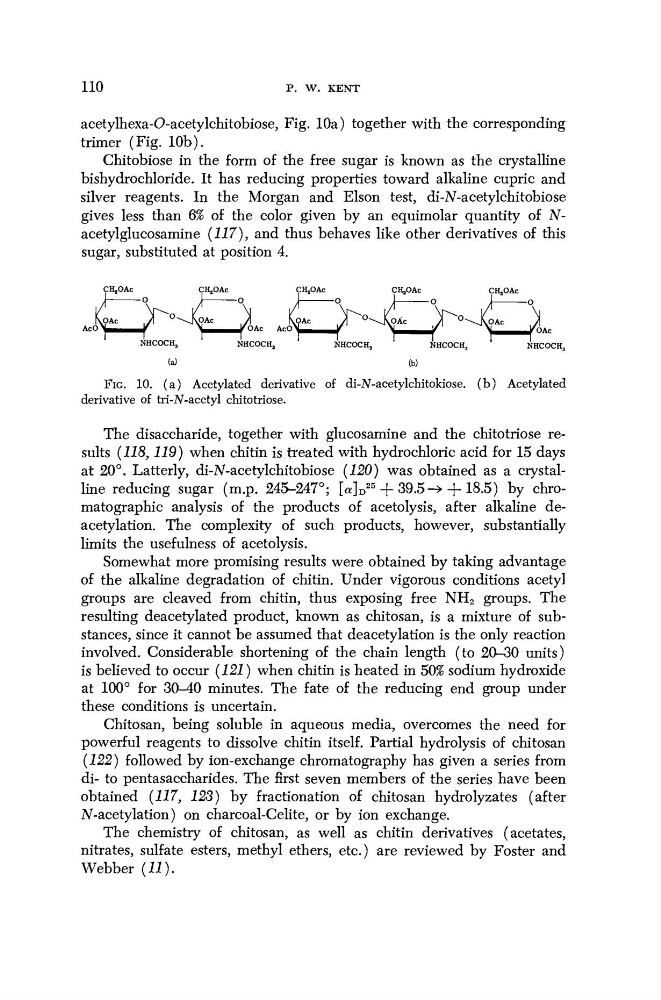
acetylhexa-O-acetylchitobiose, Fig. 10a) together with the corresponding
trimer (Fig. 10b).
Chitobiose in the form of the free sugar is known as the crystalline
bishydrochloride. It has reducing properties toward alkaline cupric and
silver reagents. In the Morgan and Elson test, di-N-acetylchitobiose
gives less than 6% of the color given by an equimolar quantity of Nacetylglucosamine (117), and thus behaves like other derivatives of this
sugar, substituted at position 4.
CH 2 OAc
CHaOAc
CI^OAc
CI^OAc
CH 2 OAc
FIG. 10. (a) Acetylated derivative of di-N-acetylchitokiose. (b) Acetylated
derivative of tri-N-acetyl chitotriose.
The disaccharide, together with glucosamine and the chitotriose results (118,119) when chitin is treated with hydrochloric acid for 15 days
at 20°. Latterly, di-N-acetylchitobiose (120) was obtained as a crystalline reducing sugar (m.p. 245-247°; [«] D
25 + 39.5-» + 18.5) by chromatographic analysis of the products of acetolysis, after alkaline deacetylation. The complexity of such products, however, substantially
limits the usefulness of acetolysis.
Somewhat more promising results were obtained by taking advantage
of the alkaline degradation of chitin. Under vigorous conditions acetyl
groups are cleaved from chitin, thus exposing free NH 2 groups. The
resulting deacetylated product, known as chitosan, is a mixture of substances, since it cannot be assumed that deacetylation is the only reaction
involved. Considerable shortening of the chain length (to 20-30 units)
is believed to occur (121) when chitin is heated in 50% sodium hydroxide
at 100° for 30-40 minutes. The fate of the reducing end group under
these conditions is uncertain.
Chitosan, being soluble in aqueous media, overcomes the need for
powerful reagents to dissolve chitin itself. Partial hydrolysis of chitosan
(122) followed by ion-exchange chromatography has given a series from
di- to pentasaccharides. The first seven members of the series have been
obtained (117, 123) by fractionation of chitosan hydrolyzates (after
N-acetylation) on charcoal-Celite, or by ion exchange.
The chemistry of chitosan, as well as chitin derivatives (acetates,
nitrates, sulfate esters, methyl ethers, etc.) are reviewed by Foster and
Webber (11).
AcO
NHCOCH3
OAc
(a)
(b)
P. W. KENT
acetylhexa-O-acetylchitobiose, Fig. 10a) together with the corresponding
trimer (Fig. 10b).
Chitobiose in the form of the free sugar is known as the crystalline
bishydrochloride. It has reducing properties toward alkaline cupric and
silver reagents. In the Morgan and Elson test, di-N-acetylchitobiose
gives less than 6% of the color given by an equimolar quantity of Nacetylglucosamine (117), and thus behaves like other derivatives of this
sugar, substituted at position 4.
CH 2 OAc
CHaOAc
CI^OAc
CI^OAc
CH 2 OAc
FIG. 10. (a) Acetylated derivative of di-N-acetylchitokiose. (b) Acetylated
derivative of tri-N-acetyl chitotriose.
The disaccharide, together with glucosamine and the chitotriose results (118,119) when chitin is treated with hydrochloric acid for 15 days
at 20°. Latterly, di-N-acetylchitobiose (120) was obtained as a crystalline reducing sugar (m.p. 245-247°; [«] D
25 + 39.5-» + 18.5) by chromatographic analysis of the products of acetolysis, after alkaline deacetylation. The complexity of such products, however, substantially
limits the usefulness of acetolysis.
Somewhat more promising results were obtained by taking advantage
of the alkaline degradation of chitin. Under vigorous conditions acetyl
groups are cleaved from chitin, thus exposing free NH 2 groups. The
resulting deacetylated product, known as chitosan, is a mixture of substances, since it cannot be assumed that deacetylation is the only reaction
involved. Considerable shortening of the chain length (to 20-30 units)
is believed to occur (121) when chitin is heated in 50% sodium hydroxide
at 100° for 30-40 minutes. The fate of the reducing end group under
these conditions is uncertain.
Chitosan, being soluble in aqueous media, overcomes the need for
powerful reagents to dissolve chitin itself. Partial hydrolysis of chitosan
(122) followed by ion-exchange chromatography has given a series from
di- to pentasaccharides. The first seven members of the series have been
obtained (117, 123) by fractionation of chitosan hydrolyzates (after
N-acetylation) on charcoal-Celite, or by ion exchange.
The chemistry of chitosan, as well as chitin derivatives (acetates,
nitrates, sulfate esters, methyl ethers, etc.) are reviewed by Foster and
Webber (11).
AcO
NHCOCH3
OAc
(a)
(b)