

12. QUINONES: STRUCTURE AND DISTRIBUTION
705
ate. However, when this compound was labeled with C
14 and fed to P.
ishndicum, none of the anthraquinones produced were radioactive
(336a). The complete failure to detect precursors, together with Gatenbeck's demonstration, already referred to, that the closely related anthraquinones formed by P. ishndicum do not have the same immediate precursors, has led Ehrensvärd and Gatenbeck (336a,
338) to the view that intermediates do not exist above the enzyme
level. They suggest that anthraquinone formation proceeds in three
stages: in the first stage acetate units are arranged in a regular manner
within an enzyme complex, this is followed by random condensation
of carbonyl groups with methyl and methylene groups leading to the
formation of different products simultaneously, which, in the third
stage, separate from the enzyme surface as definite chemical entities.
In this "all-or-nothing" process there are no intermediates, in the ordinary
sense, between a C 2 unit and a complete 15 X C 2 compound (in the
case of a dianthraquinone), and sulochrin, pinselinic acid, etc., are
regarded as secondary oxidation products derived from anthraquinones.
Probably all the fungal benzoquinones are acetate derived, and
compounds of the orsellinic acid type are postulated intermediates.
Their conversion to quinones would require nuclear oxidation, methylation, decarboxylation, and similar reactions, which Seshadri has shown
to be feasible in vitro, by laboratory syntheses of several benzoquinones
along these lines (339). That such reactions ensue in vivo has been confirmed by biological evidence concerning the biogenesis of aurantiogliocladin (LXXX). This quinone has two C-methyl and two O-methyl
groups, and an additional C-methyl group has to be introduced during
its biosynthesis [extension (c) of the simple acetate theory (p. 702)].
In separate experiments, Birch and co-workers (340) grew the mold on
media containing labeled acetate and labeled formate. The radioactive
products were then combined, reduced to the quinol, and the isotopic
distribution pattern was determined by appropriate degradations.
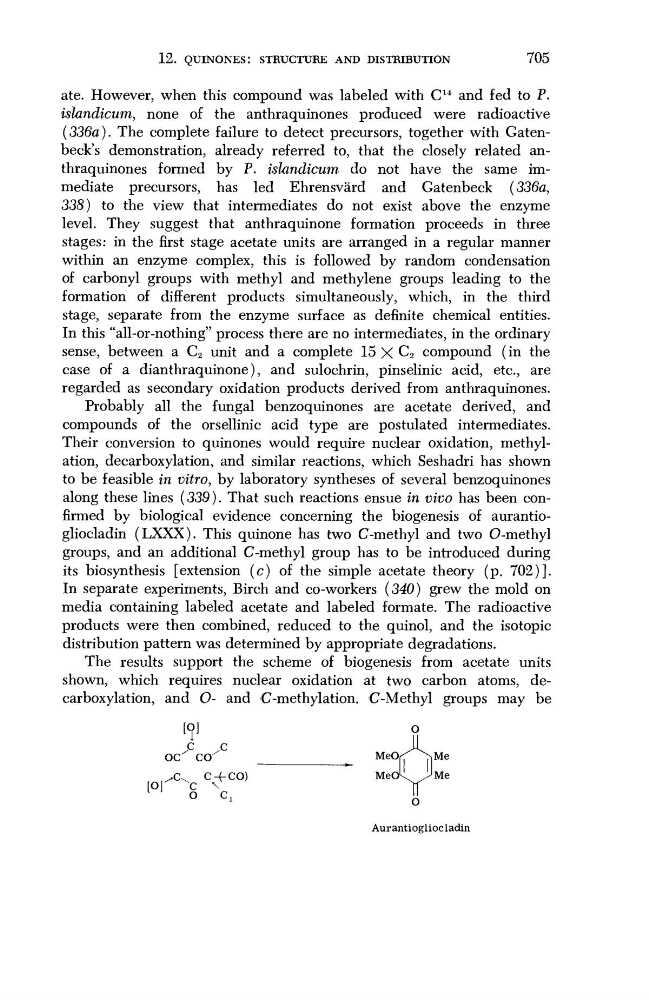
The results support the scheme of biogenesis from acetate units
shown, which requires nuclear oxidation at two carbon atoms, decarboxylation, and O- and C-methylation. C-Methyl groups may be
^
c \^ C-(-CO)
MeoLJMe
O
o
c,
Jl
Aurantiogliocladin