

706
R. H. THOMSON
introduced before or after ring formation, the process being strictly
analogous to O-, S-, and N-methylation, in which the methyl group is
transferred as CH 3
+ from an onium compound derived from methionine
or choline, to the methyl acceptor. (For a full discussion readers are
referred to Chapter 5 in Vol. I of this work.)
The fourth extension of the acetate theory—rearrangement of the
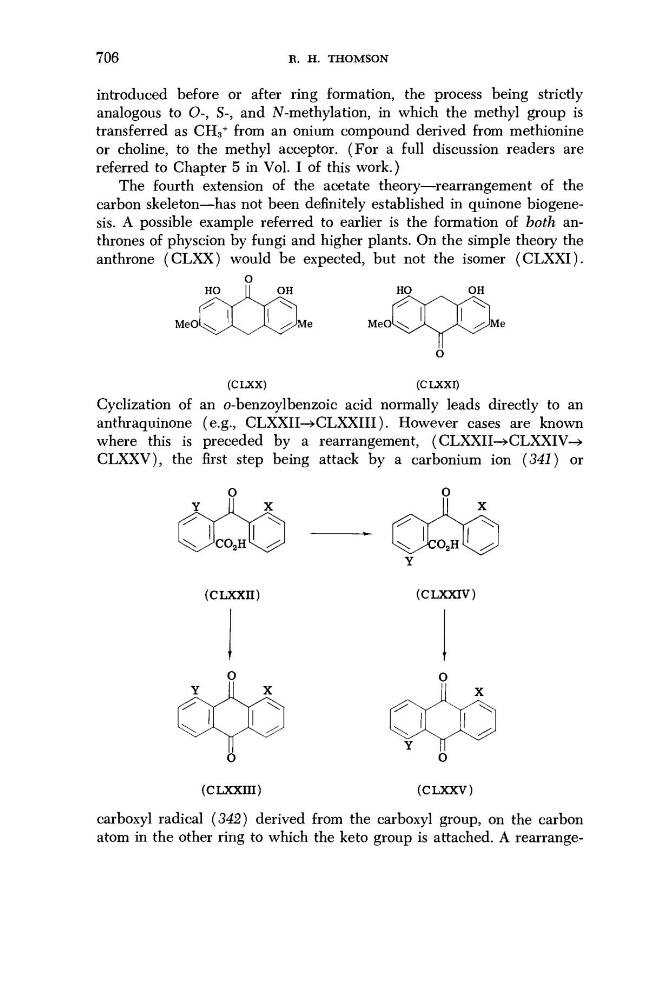
carbon skeleton—has not been definitely established in quinone biogenesis. A possible example referred to earlier is the formation of both anthrones of physcion by fungi and higher plants. On the simple theory the
anthrone (CLXX) would be expected, but not the isomer (CLXXI).
o
HO
II
OH
HO
OH
MeOl
MeO
1
(CLXX)
(CLXXI)
Cyclization of an o-benzoylbenzoic acid normally leads directly to an
anthraquinone (e.g., CLXXII—»CLXXIII). However cases are known
where this is preceded by a rearrangement, (CLXXII-»CLXXIV->
CLXXV), the first step being attack by a carbonium ion (341) or
(CLXXII)
(CLXXIV)
(CLXXIII)
(CLXXV)
carboxyl radical (342) derived from the carboxyl group, on the carbon
atom in the other ring to which the keto group is attached. A rearrange-