

704
R. H. THOMSON
show that rubroskyrin and luteoskyrin (CXVI and CXVIII), hydrated
forms of iridoskyrin analogous to flavoskyrin, are not precursors of iridoskyrin. Nor, conversely, is iridoskyrin a precursor of its hydrated forms,
whence it follows that the immediate precursors of the diquinone, and
of its hydrated forms, are different. These findings emphasize our general ignorance of the precise pathways by which two-carbon units are
built up to form complex ring systems. The biosynthesis from labeled
precursors of certain quinones, and a variety of other mold metabolites,
giving products having the predicted isotopic distribution pattern, is
conclusive proof of the acetate hypothesis, but further study is now
required to put it on a sound biochemical basis by isolation of intermediate products, if possible (see below), and identification of the
enzymes that promote the sequence of reactions.
The biogenesis of the fungal anthraquinones has provoked considerable speculation. Seshadri has discussed the formation of fungal (333)
and lichen (334) products, and considers a C 8 unit (orsellinic acid) to
be of great importance in the formation of quinones (335) as well as
the depsides and depsidones. This, of course, fits into the acetate
theory. Two C 8 units are required to construct the anthraquinones, but
although it is possible to formulate reaction schemes there is no
evidence whatsoever that orsellinic acid, or related compounds, are
actual intermediates. Raistrick (336) pointed out some years ago that a
number of simple phenolic acids produced by molds are possible intermediates in the biogenesis of anthraquinones, but it has been shown
(336a) that 3-hydroxyphthalic acid [yet another acetate-derived metabolite of P. islandicum (337)], is not a precursor of islandicin, and 6methylsalicyclic acid, conceivably a precursor, completely inhibits anthraquinone formation by this organism. It has also been suggested
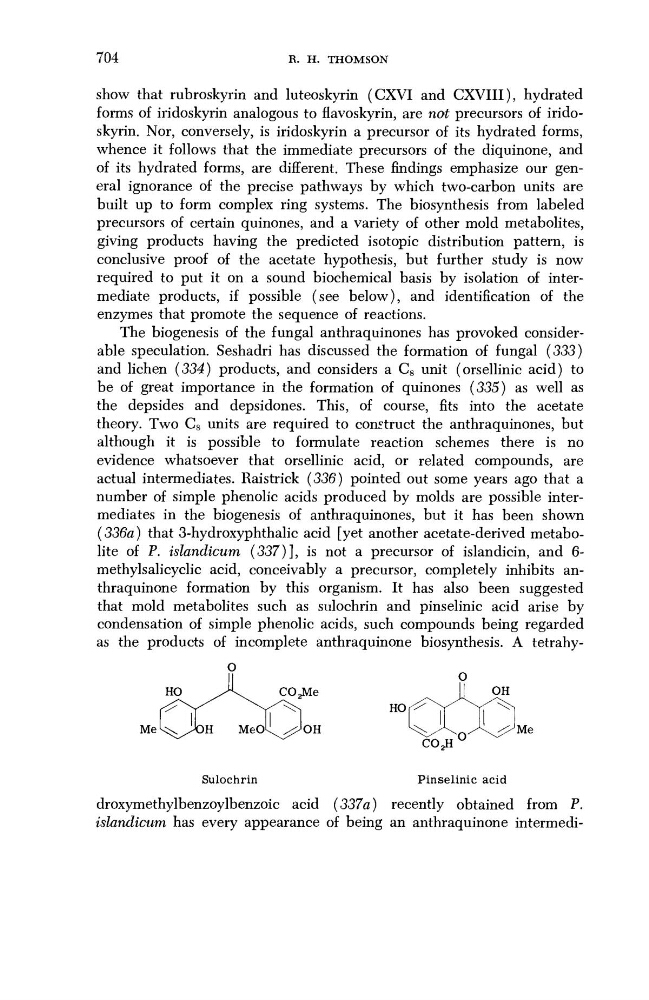
that mold metabolites such as sulochrin and pinselinic acid arise by
condensation of simple phenolic acids, such compounds being regarded
as the products of incomplete anthraquinone biosynthesis. A tetrahySulochrin
Pinselinic acid
droxymethylbenzoylbenzoic acid (337a) recently obtained from P.
islandicum has every appearance of being an anthraquinone intermedi-