

12. QUINONES: STRUCTURE AND DISTRIBUTION
703
CO
.CO
CO
*
c
c
c
C4-CO)
*
*
*
*
CO
CO
CO
CO —C
^c
^c
x c
Flavoskyrin
Endocrocin
(CLXIX)
(CLXVII)
Chrysophanol
Emodin
(CLXVIII)
structure, characterized by the absence of oxygen in "expected" positions, or possessing "additional" oxygen substituents, or both. These
can be accounted for by appropriate oxidations, reductions, and dehydrations, as already mentioned, and in two cases, helminthosporin (329)
and islandicin (330), biosynthesis from acetate units has again been
established by iso topic experiments. Gatenbeck (330) has gone further
by using CH 3 C
14 00
18 H in feeding experiments with P. islandicum. In
this way it was possible to distinguish between the oxygen atoms of
islandicin that are derived from acetate carboxyl oxygen and those that
are introduced by secondary oxidation. These findings were also in
agreement with expectations based on the acetate theory.
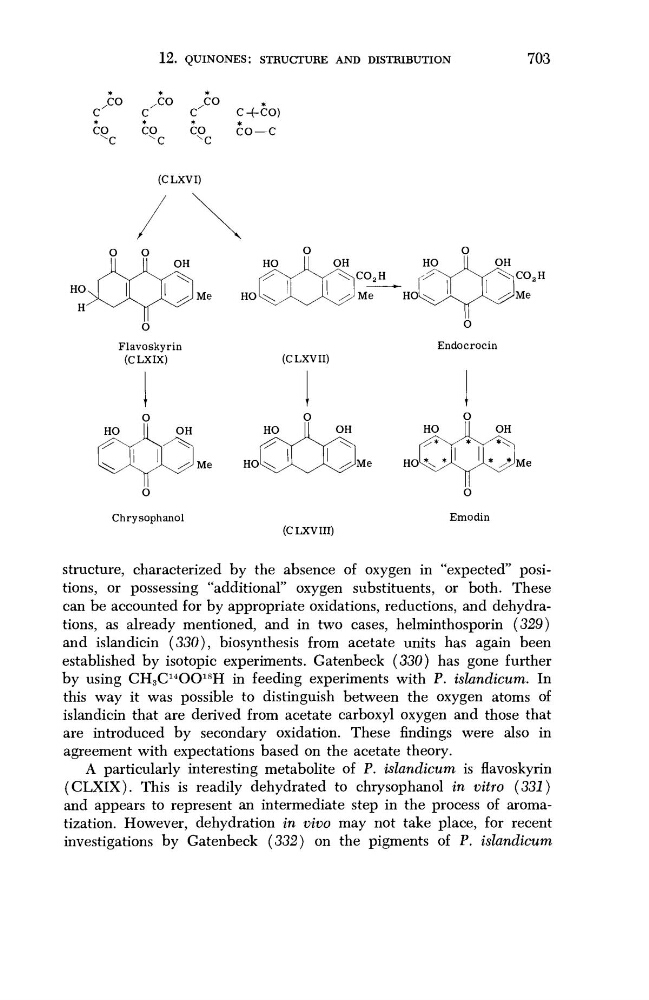
A particularly interesting metabolite of P. islandicum is flavoskyrin
(CLXIX). This is readily dehydrated to chrysophanol in vitro (331)
and appears to represent an intermediate step in the process of aromatization. However, dehydration in vivo may not take place, for recent
investigations by Gatenbeck (332) on the pigments of P. islandicum