

702
R. H. THOMSON
the cyclization of β-polyketones formed by head-to-tail linkage of acetate units, additional reactions may take place which bring about (a)
elimination of oxygen (as in the formation of 6-methylsalicylic acid);
(b) introduction of oxygen; (c) introduction of substituents, notably
methyl, isopentenyl, and related groups; and (d) rearrangement of the
carbon skeleton. Introduction of oxygen to aromatic systems is a common
biological process (153) and of particular importance in the biogenesis
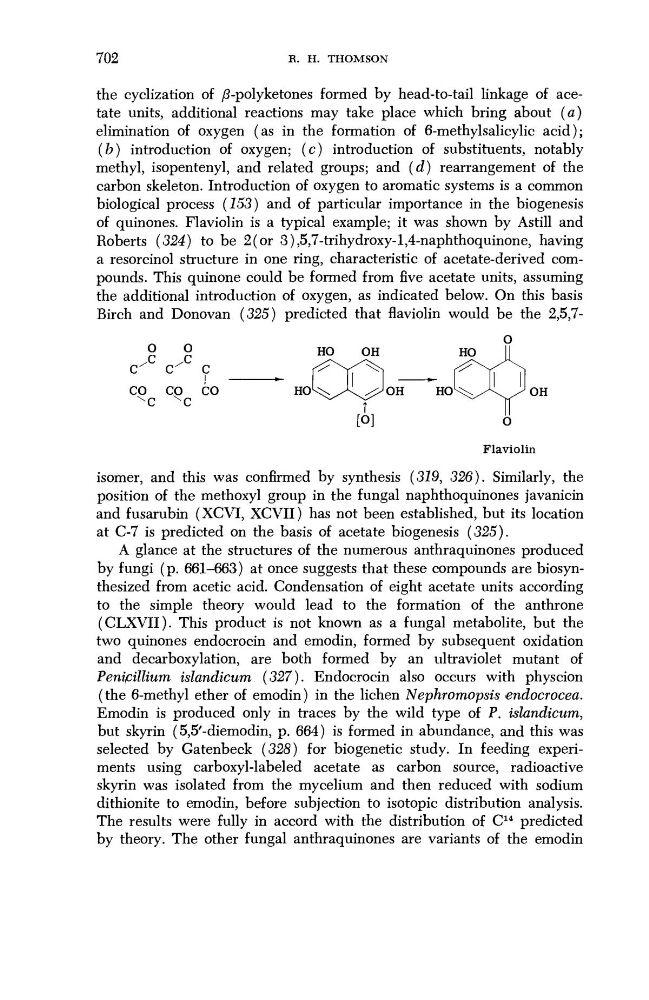
of quinones. Flaviolin is a typical example; it was shown by Astill and
Roberts (324) to be 2(or 3),5,7-trihydroxy-l,4-naphthoquinone, having
a resorcinol structure in one ring, characteristic of acetate-derived compounds. This quinone could be formed from five acetate units, assuming
the additional introduction of oxygen, as indicated below. On this basis
Birch and Donovan (325) predicted that flaviolin would be the 2,5,7O
O
C^
C'
C
CO
CO
CO
x c
x c
Flaviolin
isomer, and this was confirmed by synthesis (319, 326). Similarly, the
position of the methoxyl group in the fungal naphthoquinones javanicin
and fusarubin (XCVI, XCVII) has not been established, but its location
at C-7 is predicted on the basis of acetate biogenesis (325).
A glance at the structures of the numerous anthraquinones produced
by fungi (p. 661-663) at once suggests that these compounds are biosynthesized from acetic acid. Condensation of eight acetate units according
to the simple theory would lead to the formation of the anthrone
(CLXVII). This product is not known as a fungal metabolite, but the
two quinones endocrocin and emodin, formed by subsequent oxidation
and decarboxylation, are both formed by an ultraviolet mutant of
Penifillium islandicwm (327). Endocrocin also occurs with physcion
(the 6-methyl ether of emodin) in the lichen Nephromopsis endocrocea.
Emodin is produced only in traces by the wild type of P. islandicum,
but skyrin (5,5'-diemodin, p. 664) is formed in abundance, and this was
selected by Gatenbeck (328) for biogenetic study. In feeding experiments using carboxyl-labeled acetate as carbon source, radioactive
skyrin was isolated from the mycelium and then reduced with sodium
dithionite to emodin, before subjection to isotopic distribution analysis.
The results were fully in accord with the distribution of C
14 predicted
by theory. The other fungal anthraquinones are variants of the emodin