

12. QUINONES: STRUCTURE AND DISTRIBUTION
701
odd number of carbon atoms) by addition of unreduced acetate units
could lead to a polyketone (CLX), from which orcinol (CLXII) or
phloroglucinol (CLXIII) derivatives could arise by internal aldol or
C-acylation reactions, respectively. Orsellinic acid (CLXII; R = Me) is
a constituent of a large number of depsides and depsidones elaborated
by lichens. Decarboxylation of (CLXII) could give the orcinol (CLXI);
and reduction, followed by dehydration, of one of the carbonyl groups
in (CLX) not involved in the cyclization, would lead to (CLXIV). It
will be noted that all the aromatic compounds are formed by straightforward reactions for which in vitro and in vivo analogies exist. 6Methylsalicylic acid (CLXIV; R = Me) was the first compound used
by Birch et al. (321) to test the acetate hypothesis. Microorganisms are
very convenient for studies of this kind as they can be readily grown
in the laboratory under controlled conditions. Experiment has shown
that many organisms initially break down glucose to acetate (presumably via the Embden-Meyerhof pathway), so that the biosynthesis
of aromatic compounds from the latter can be followed by feeding
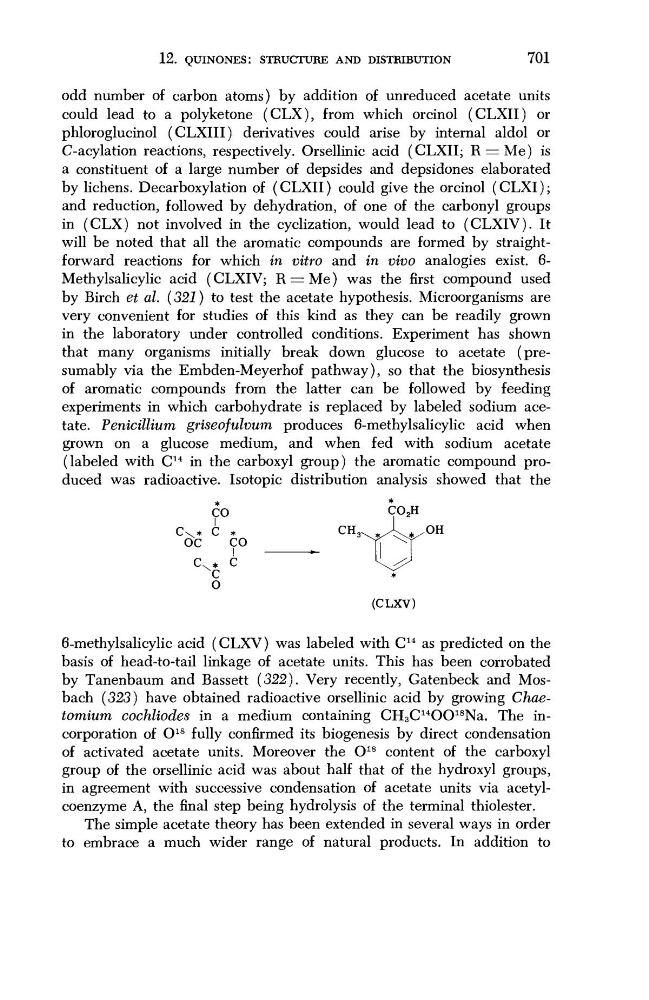
experiments in which carbohydrate is replaced by labeled sodium acetate. Penicillium griseofulvum produces 6-methylsalicylic acid when
grown on a glucose medium, and when fed with sodium acetate
(labeled with C
14 in the carboxyl group) the aromatic compound produced was radioactive. Isotopic distribution analysis showed that the
*
CO
I
C\* C *
OC
CO
I
c x * c
c
o
6-methylsalicylic acid (CLXV) was labeled with C
14 as predicted on the
basis of head-to-tail linkage of acetate units. This has been corrobated
by Tanenbaum and Bassett (322). Very recently, Gatenbeck and Mosbach (323) have obtained radioactive orsellinic acid by growing Chaetomium cochliodes in a medium containing CH 3 C
14 00
18 Na. The incorporation of O
18 fully confirmed its biogenesis by direct condensation
of activated acetate units. Moreover the O
18 content of the carboxyl
group of the orsellinic acid was about half that of the hydroxyl groups,
in agreement with successive condensation of acetate units via acetylcoenzyme A, the final step being hydrolysis of the terminal thiolester.
The simple acetate theory has been extended in several ways in order
to embrace a much wider range of natural products. In addition to
CH
(CLXV)