

700
R. H. THOMSON
B. ACETATE ROUTE
The idea that phenolic compounds might be evolved in nature by
head-to-tail linkage of acetic acid units was first proposed by Collie
(316) and was based on laboratory experiments in which he found that
polyketones (e.g., diacetylacetone) could be condensed to form orcinol
and other compounds related to natural products. At that time there
was no means of testing this hypothesis, and it was forgotten. Similar
views were expressed much later by Robinson (317), and more recently
Birch (318) has extended and elaborated the acetate theory and has
provided conclusive experimental evidence. The biosynthesis of fats and
steroids by condensation of activated acetate units is now well established, and the most recent data on the formation of aromatic compounds by this route suggest a close parallel. In the formation of fatty
acids (see Chapter 1, this volume) the carbonyl groups are eliminated by
reduction and dehydration, but in phenol biogenesis most of the oxygen
atoms remain attached to the carbon skeleton and can thus be recognized. Inspection of formulas suggested that many groups of phenolic
substances, in particular, the fungal anthraquinones (319), were built
up from acetate units, and moreover such scrutiny led to the discovery
of erroneous structures and to the correct prediction of new ones. This
gave strong support to the hypothesis prior to experimental verification.
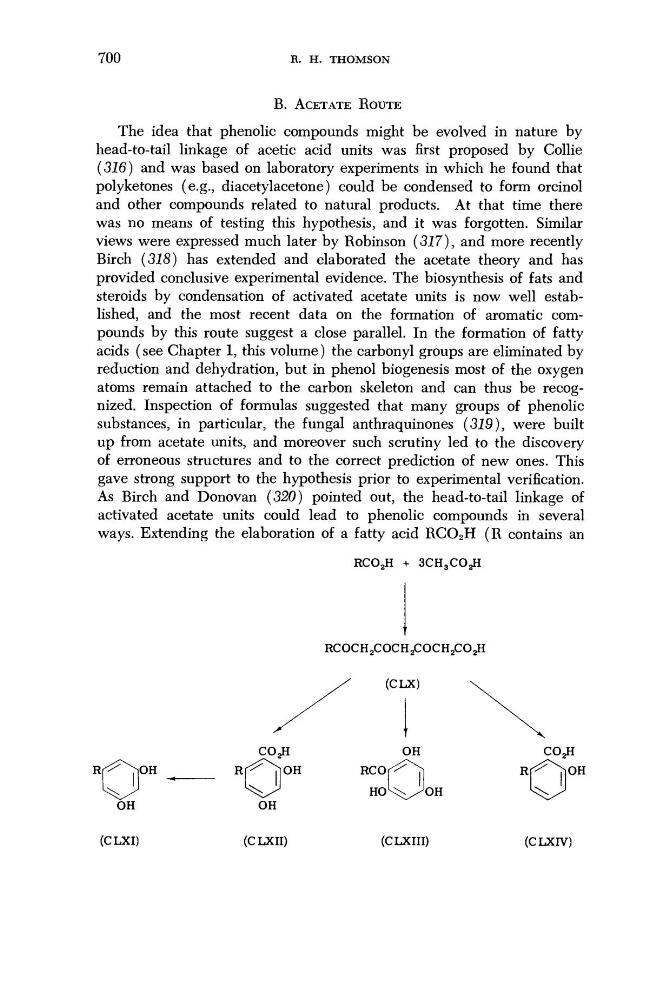
As Birch and Donovan (320) pointed out, the head-to-tail linkage of
activated acetate units could lead to phenolic compounds in several
ways. Extending the elaboration of a fatty acid RC0 2 H (R contains an
R
^Tl
OH
_
kj OH
(CLXI)
CO^
Rr^>|OH
KJ> OH
(CLXII)
RCO z H -
RCOCH 2 COCi
/
(CL
i- 3CH 3
1
I 2 COCH
Ä)
T
OH
Rcor^
ΗΟ^^/ΌΗ
(CK Kill)
COjjH
,ΟΟ,Η
CO,>H
ΗΓ^,ΟΗ
kJ
(CLXIV)