

692
R. H. THOMSON
with a second substance, separable on paper chromatograms, which
also had an absorption peak at 275 πΐμ, and an additional inflection at
330 τημ. These two substances were designated SA and SC, respectively,
by Morton and associates (280), and the former was recognized as a
quinone (Q275) by Crane et dl. (281), who isolated crystalline material m.p. 48-49°, from beef heart mitochondria, and various electrontransporting particles derived therefrom. Detailed evidence for the
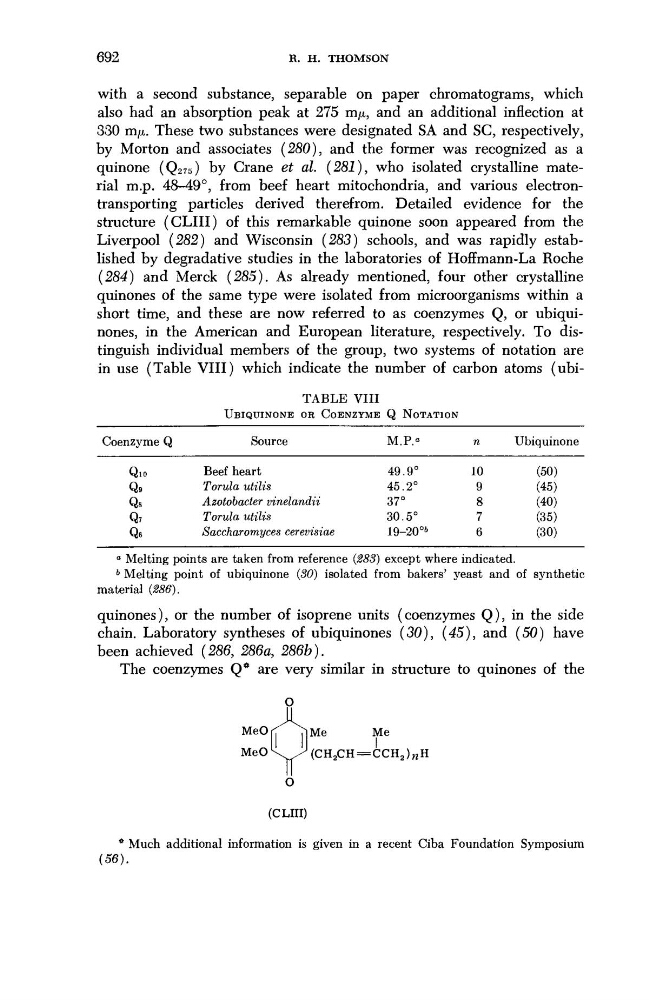
structure (CLIII) of this remarkable quinone soon appeared from the
Liverpool (282) and Wisconsin (283) schools, and was rapidly established by degradative studies in the laboratories of Hoffmann-La Roche
(284) and Merck (285). As already mentioned, four other crystalline
quinones of the same type were isolated from microorganisms within a
short time, and these are now referred to as coenzymes Q, or ubiquinones, in the American and European literature, respectively. To distinguish individual members of the group, two systems of notation are
in use (Table VIII) which indicate the number of carbon atoms (ubiTABLE VIII
UBIQUINONE OR COENZYME Q NOTATION
Coenzyme Q
Q10
Q9
Qs
QT
Q 6
Source
Beef heart
Torula utilis
Azotobacter vinelandii
Torula utilis
Saccharomyces cerevisiae
M.P.«
49.9°
45.2°
37°
30.5°
19-20
Ob
n
10
9
8
7
6
Ubiquinone
(50)
(45)
(40)
(35)
(30)
0 Melting points are taken from reference (283) except where indicated.
6 Melting point of ubiquinone (30) isolated from bakers' yeast and of synthetic
material (286).
quinones), or the number of isoprene units (coenzymes Q), in the side
chain. Laboratory syntheses of ubiquinones (30), (45), and (50) have
been achieved (286, 286a, 286b).
The coenzymes Q* are very similar in structure to quinones of the
O
MeOrjjjMe
Me
MeokJ(CH 2 CH==CCH 2 ) w H
O
(CLIII)
* Much additional information is given in a recent Ciba Foundation Symposium
(56).