

12. QUINONES: STRUCTURE AND DISTRIBUTION
693
vitamin K 2 series elaborated by bacteria and to plastoquinone found in
green leaves. Coenzyme Q 10 , most commonly encountered in higher
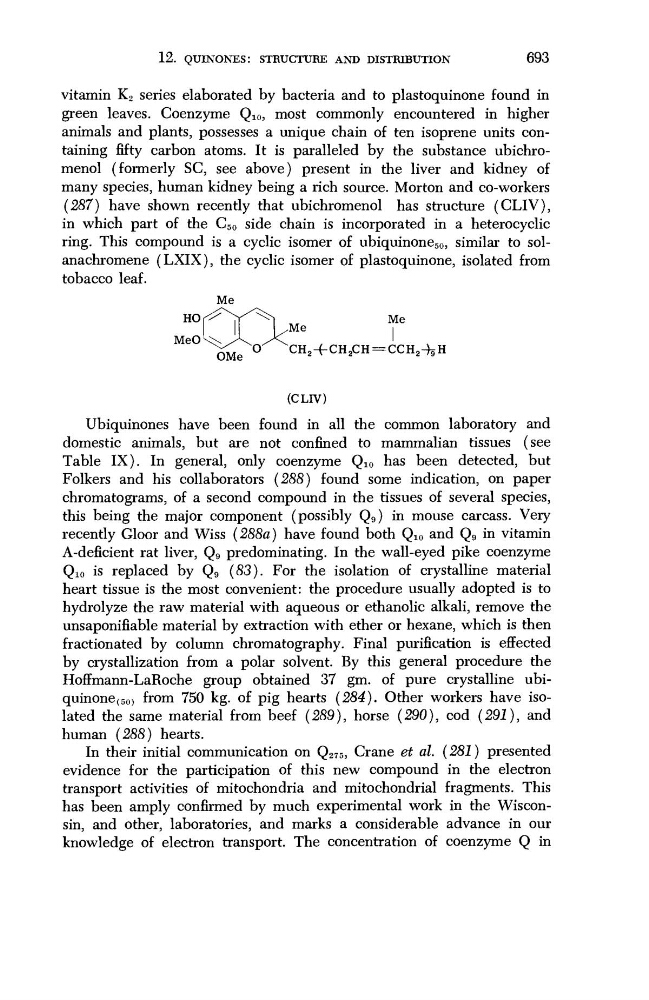
animals and plants, possesses a unique chain of ten isoprene units containing fifty carbon atoms. It is paralleled by the substance ubichromenol (formerly SC, see above) present in the liver and kidney of
many species, human kidney being a rich source. Morton and co-workers
(287) have shown recently that ubichromenol has structure (CLIV),
in which part of the C 50 side chain is incorporated in a heterocyclic
ring. This compound is a cyclic isomer of ubiquinone 50 , similar to solanachromene (LXIX), the cyclic isomer of plastoquinone, isolated from
tobacco leaf.
Me
Me
Me
I
OMe
v
CH 2 -^CH 2 CH = CCH 2 49H
(CLIV)
Ubiquinones have been found in all the common laboratory and
domestic animals, but are not confined to mammalian tissues (see
Table IX). In general, only coenzyme Qio has been detected, but
Folkers and his collaborators (288) found some indication, on paper
chromatograms, of a second compound in the tissues of several species,
this being the major component (possibly Q 9 ) in mouse carcass. Very
recently Gloor and Wiss (288a) have found both Q 10 and Q 9 in vitamin
A-deficient rat liver, Q 9 predominating. In the wall-eyed pike coenzyme
Qio is replaced by Q 9 (83). For the isolation of crystalline material
heart tissue is the most convenient: the procedure usually adopted is to
hydrolyze the raw material with aqueous or ethanolic alkali, remove the
unsaponifiable material by extraction with ether or hexane, which is then
fractionated by column chromatography. Final purification is effected
by crystallization from a polar solvent. By this general procedure the
Hoffmann-LaRoche group obtained 37 gm. of pure crystalline ubiquinone (50 ) from 750 kg. of pig hearts (284). Other workers have isolated the same material from beef (289), horse (290), cod (291), and
human (288) hearts.
In their initial communication on Q275, Crane et al. (281) presented
evidence for the participation of this new compound in the election
transport activities of mitochondria and mitochondrial fragments. This
has been amply confirmed by much experimental work in the Wisconsin, and other, laboratories, and marks a considerable advance in our
knowledge of electron transport. The concentration of coenzyme Q in
HO
MeO