

690
R. H. THOMSON
has long been known that sea urchin eggs secrete substances that stimulate sperm in a powerful manner. In some species this secretion is a
protein complex containing echinochrome A, and according to Hartmann
et al. (257) the pigment itself (from the eggs of Arbacia lixula) has
the same activating properties and is effective in a dilution of one part
in 2.5 X 10
9 parts of sea water. This has been denied by other workers
(256, 258), and Cornman (258) has pointed out that echinochrome A is
of limited occurrence in the eggs of Echinoidea, and moreover egg
secretions from pigmented eggs will stimulate sperm from unpigmented
species, and vice versa. The wider distribution of naphthoquinones in
the body and spines of these animals may be of more significance. Recent work by Millott and Yoshida (259) on the spectral sensitivity of
echinoids suggests the possibility that these pigments may be involved
in photoreception. Sea urchins are highly sensitive to light of appropriate wavelength and it was found that the maximum sensitivity of
Diadema antillarum (at 465 τημ) almost coincided with the absorption
maximum (462-463 m/x) of the quinone pigment found throughout this
animal. Further work in this direction may reveal the true function of
these coloring matters.
b. Holothurioidea. There is only one record of the occurrence of a
quinone in this class. Mukai (260) has recently found that the purple
pigment of the sea cucumber Palycheira rufescens (Brandt) is a chromoprotein readily extracted from whole animals with aqueous acetic acid.
After precipitation with methanol and treatment with hydrochloric acid,
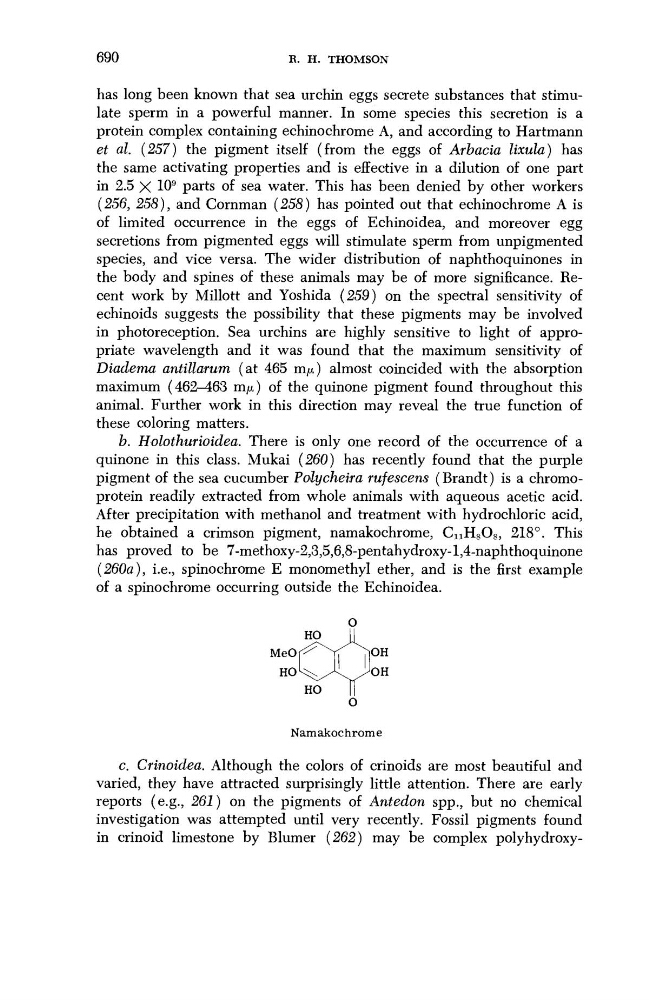
he obtained a crimson pigment, namakochrome, CnH 8 0 8 , 218°. This
has proved to be 7-methoxy-2,3,5,6,8-pentahydroxy-l,4-naphthoquinone
(260a), i.e., spinochrome E monomethyl ether, and is the first example
of a spinochrome occurring outside the Echinoidea.
O
HO
N
MeO r^^>^||OH
HoU^^JW
HO if
O
Namakochrome
c. Crinoidea. Although the colors of crinoids are most beautiful and
varied, they have attracted surprisingly little attention. There are early
reports (e.g., 261) on the pigments of Antedon spp., but no chemical
investigation was attempted until very recently. Fossil pigments found
in crinoid limestone by Blumer (262) may be complex polyhydroxy-