

12. QUINONES: STRUCTURE AND DISTRIBUTION
W
o
0
Et ~
I 10H
HO ~
OH
HO
o
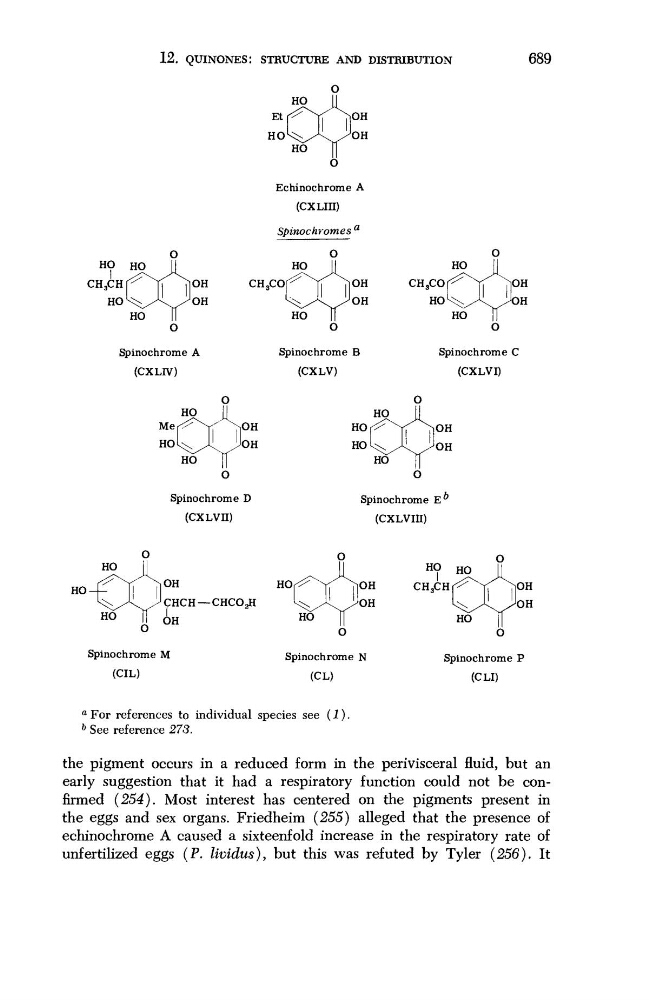
Echinochrome A
(CXLIII)
Spinockromes a
689
HO~O 0
CH,6H /""
I I OH
HO 0-,.
OH
HO
o
Spinochrome A
(CXLN)
o
~
o
CHsCO /
I IOH
'~
OH
HO
o
Spinochrome B
(CXLV)
o
~
o
CHgCO '?'
I IOH
HO ~
OH
HO
o
Spinochrome C
(CXLVI)
~
o
0
Me ,/
OH
HO ~ I 10H
HO
o
Spinochrome D
(CXLVII)
~
o
0
HO /"
I I OH
HO 0-,.
OH
HO
o
Spinochrome E b
(CXLVIll)
o
-9)
0
HO /"
OH
0.
I I ?HCH-CHCO"H
HO
OH
o
Spinochrome M
(CIL)
H001°\OH
~
OH
HO
o
Spinochrome N
(CL)
HO W
O
0
CH,6H /""
I IOH
0-,.
OH
HO
o
Spinochrome P
(CLI)
a For references to individual species see (1).
b See reference 273.
the pigment occurs in a reduced form in the perivisceral fluid, but an
early suggestion that it had a respiratory function could not be confirmed (254). Most interest has centered on the pigments present in
the eggs and sex organs. Friedheim (255) alleged that the presence of
echinochrome A caused a sixteenfold increase in the respiratory rate of
unfertilized eggs (P. lividus) , but this was refuted by Tyler (256). It