

688
R. H. THOMSON
tracted by treating the spines with hydrochloric acid under ether. If the
ether solution is then chromatographed on a column of calcium carbonate, the original colors of the spines are reproduced on the column.
It will be noted in Table VII that the spinochromes frequently occur
as mixtures, a different ratio producing color variations within the same
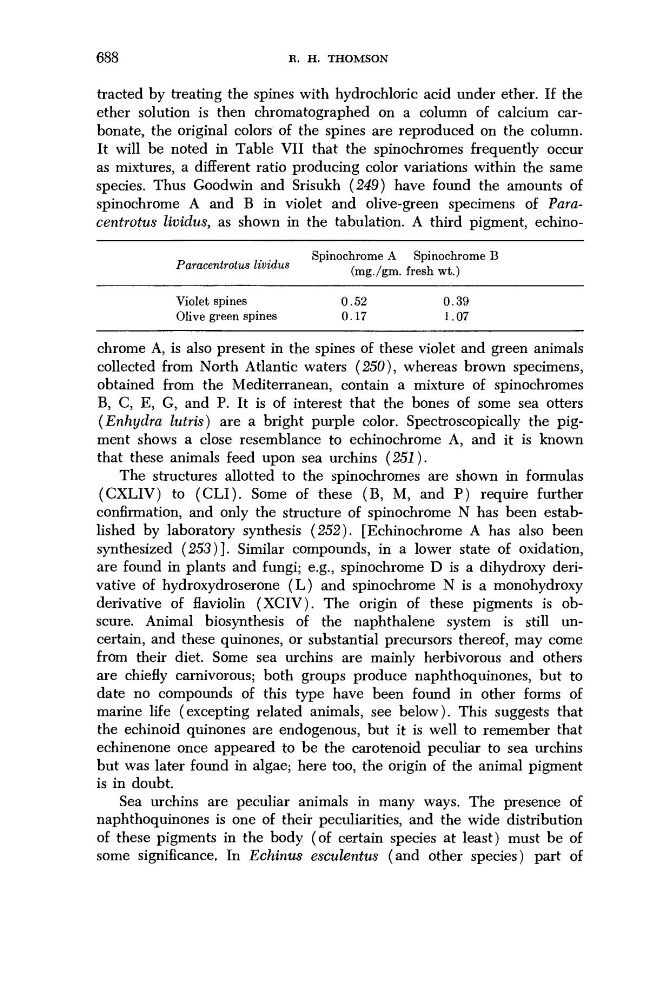
species. Thus Goodwin and Srisukh (249) have found the amounts of
spinochrome A and B in violet and olive-green specimens of Paracentrotus lividus, as shown in the tabulation. A third pigment, echinoSpinochrome A Spinochrome B
Paracentrotus lividus
(mg./gm. fresh wt.)
Violet spines
0.52
0.39
Olive green spines
0.17
1.07
chrome A, is also present in the spines of these violet and green animals
collected from North Atlantic waters (250), whereas brown specimens,
obtained from the Mediterranean, contain a mixture of spinochromes
B, C, E, G, and P. It is of interest that the bones of some sea otters
(Enhydra lutris) are a bright purple color. Spectroscopically the pigment shows a close resemblance to echinochrome A, and it is known
that these animals feed upon sea urchins (251).
The structures allotted to the spinochromes are shown in formulas
(CXLIV) to (CLI). Some of these (B, M, and P) require further
confirmation, and only the structure of spinochrome N has been established by laboratory synthesis (252). [Echinochrome A has also been
synthesized (253)]. Similar compounds, in a lower state of oxidation,
are found in plants and fungi; e.g., spinochrome D is a dihydroxy derivative of hydroxydroserone (L) and spinochrome N is a monohydroxy
derivative of flaviolin (XCIV). The origin of these pigments is obscure. Animal biosynthesis of the naphthalene system is still uncertain, and these quinones, or substantial precursors thereof, may come
from their diet. Some sea urchins are mainly herbivorous and others
are chiefly carnivorous; both groups produce naphthoquinones, but to
date no compounds of this type have been found in other forms of
marine life (excepting related animals, see below). This suggests that
the echinoid quinones are endogenous, but it is well to remember that
echinenone once appeared to be the carotenoid peculiar to sea urchins
but was later found in algae; here too, the origin of the animal pigment
is in doubt.
Sea urchins are peculiar animals in many ways. The presence of
naphthoquinones is one of their peculiarities, and the wide distribution
of these pigments in the body (of certain species at least) must be of
some significance. In Echinus escutentus (and other species) part of