

12. QUINONES: STRUCTURE AND DISTRIBUTION
687
amount is small, but aggregates are observable in the gonads of both
sexes and in other tissues (245).
The quinones present in the spines and test of sea urchins, in addition to echinochrome A which is also a fairly common spine pigment,
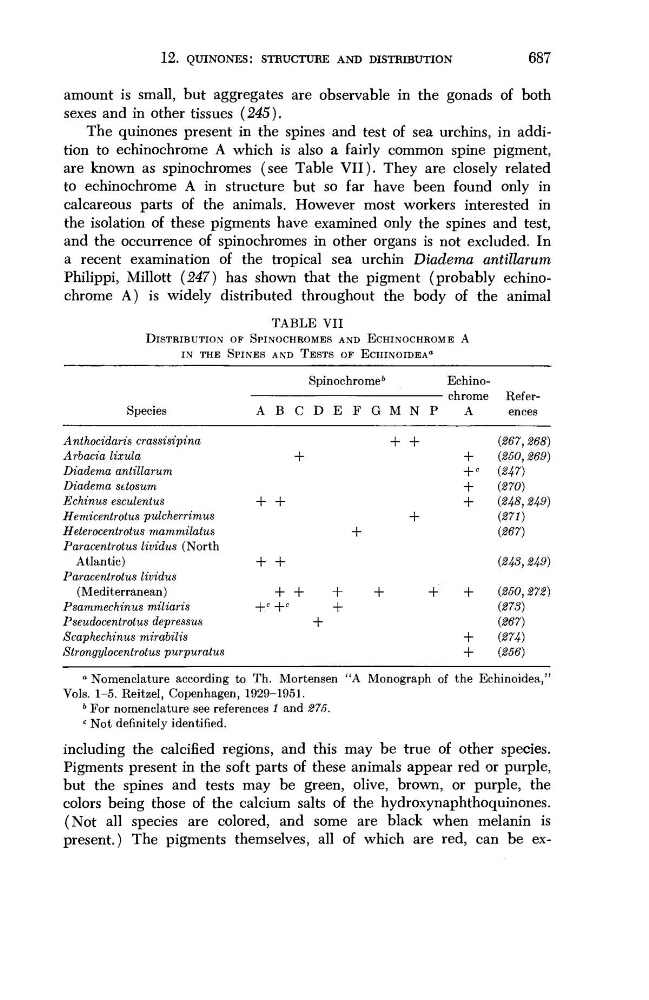
are known as spinochromes (see Table VII). They are closely related
to echinochrome A in structure but so far have been found only in
calcareous parts of the animals. However most workers interested in
the isolation of these pigments have examined only the spines and test,
and the occurrence of spinochromes in other organs is not excluded. In
a recent examination of the tropical sea urchin Diadema antiUarum
Philippi, Millott (247) has shown that the pigment (probably echinochrome A) is widely distributed throughout the body of the animal
TABLE VII
DISTRIBUTION OF SPINOCHROMES AND ECHINOCHROME A
IN THE SPINES AND TESTS OF ECHINOIDEA"
Species
Anthocidaris
crassisipina
Arbacia lixula
Diadema antiUarum
Diadema setosum
Echinus esculentus
Hemicentrotus pulcherrimus
Heterocentrotus mammilatus
Paracentrotus lividus (North
Atlantic)
Paracentrotus lividus
(Mediterranean)
Psammechinus
miliaris
Pseudocentrotus depressus
Scaphechinus mirabilis
Strongylocentrotus
purpuratus
A
+
+
+
c
B
+
+
+
+
c
C
+
+
Spinochrome
6
D
+
E F G M
+
+
+
+
+
N
+
+
P
+
Echinochrome
A
+
+
c
+
+
+
+
+
References
(267, 268)
(250, 269)
W)
(270)
(248, 249)
(271)
(267)
(243, 249)
(250, 272)
(273)
(267)
(274)
(256)
a Nomenclature according to Th. Mortensen "A Monograph of the Echinoidea,"
Vols. 1-5. Reitzel, Copenhagen, 1929-1951.
6 For nomenclature see references 1 and 275.
c Not definitely identified.
including the calcified regions, and this may be true of other species.
Pigments present in the soft parts of these animals appear red or purple,
but the spines and tests may be green, olive, brown, or purple, the
colors being those of the calcium salts of the hydroxynaphthoquinones.
(Not all species are colored, and some are black when melanin is
present.) The pigments themselves, all of which are red, can be ex-