

682
R. H. THOMSON
in content, and the quinones most probably arise from this, perhaps
through the metabolic activity of symbiotic microorganisms in the
mycetomes (224). The flesh of many Cactaceae has been observed to
redden when cut and exposed to air, and two of the host trees of the
lac insects Butea frondosa (Leguminosae) and Zizyphus
jujuba
(Rhamnaceae) * belong to families which elaborate anthraquinones, but
there is no evidence at present that suggests that the insect pigments or
substantial precursors thereof are obtained directly from the plants on
which they feed.
c. Aphins. These remarkable pigments were first examined ninety
years ago by Sorby (225) in a study of the "red Aphides" found on the
bark of apple trees [presumably the common woolly aphid Eriosoma
lanigerum (Hausmann)]. Isolated observations were recorded later by
other workers but the structures of these compounds remained unknown
until recently. The researches of Todd and his collaborators have shown
that the aphins are complex polycyclic quinones built on a coronene
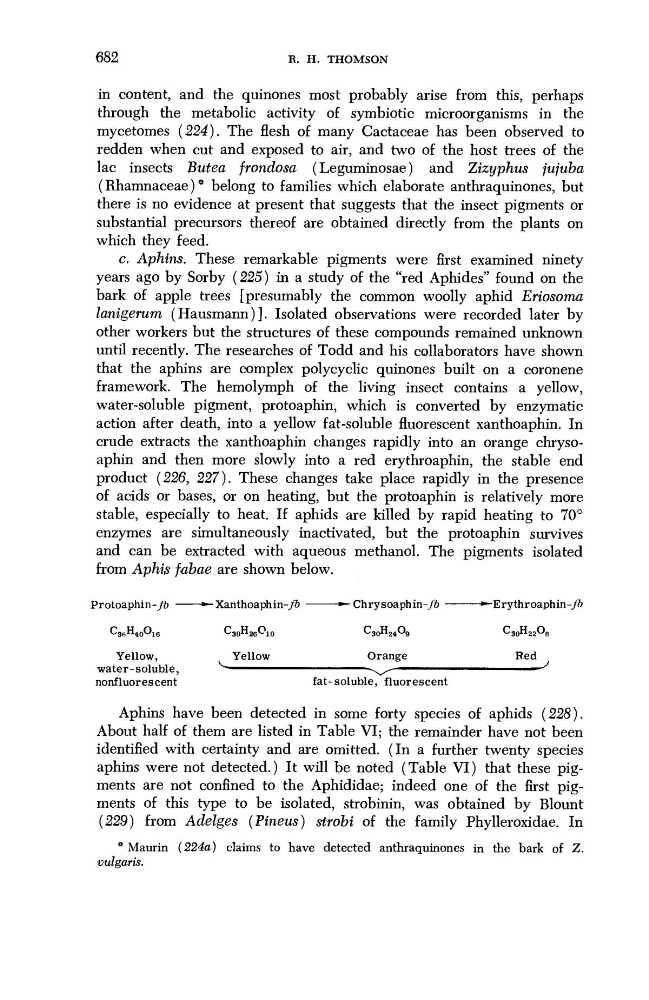
framework. The hemolymph of the living insect contains a yellow,
water-soluble pigment, protoaphin, which is converted by enzymatic
action after death, into a yellow fat-soluble fluorescent xanthoaphin. In
crude extracts the xanthoaphin changes rapidly into an orange chrysoaphin and then more slowly into a red erythroaphin, the stable end
product (226, 227). These changes take place rapidly in the presence
of acids or bases, or on heating, but the protoaphin is relatively more
stable, especially to heat. If aphids are killed by rapid heating to 70°
enzymes are simultaneously inactivated, but the protoaphin survives
and can be extracted with aqueous methanol. The pigments isolated
from Aphi# fabae are shown below.
Protoaphin-/^
*-Xanthoaphin-./&
*- Chrysoaphin-/6
*-Erythroaphin-/Z>
^3βΗ 40 Ο 16
C 30 H 26 O 10
C 30 H 2 4O 9
C 3 oH 2 20 8
Yellow,
Yellow
Orange
Red
water-soluble,
^^nonfluorescent
fat-soluble, fluorescent
Aphins have been detected in some forty species of aphids (-228).
About half of them are listed in Table VI; the remainder have not been
identified with certainty and are omitted. (In a further twenty species
aphins were not detected.) It will be noted (Table VI) that these pigments are not confined to the Aphididae; indeed one of the first pigments of this type to be isolated, strobinin, was obtained by Blount
(229) from Adelges (Pineus) strobi of the family Phylleroxidae. In
* Maurin (224a) claims to have detected anthraquinones in the bark of Z.
vulgaris.