

12. QUINONES: STRUCTURE AND DISTRIBUTION
681
O
H
H
OHO
^γ—CH—C —C —C —C — CH 2 OH
JOH
I I l I
gl
H O H H
OH
H
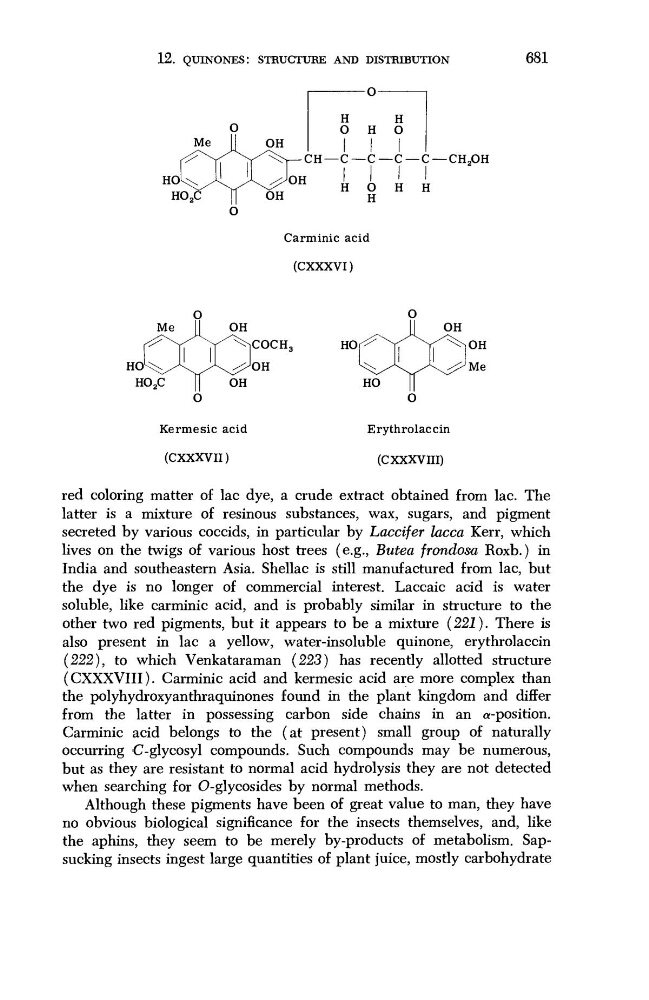
Carminic acid
(CXXXVI)
Kermesic acid
Erythrolaccin
(CXXXVII)
(CXXXVIII)
red coloring matter of lac dye, a crude extract obtained from lac. The
latter is a mixture of resinous substances, wax, sugars, and pigment
secreted by various coccids, in particular by Laccifer lacca Kerr, which
lives on the twigs of various host trees (e.g., Butea frondosa Roxb.) in
India and southeastern Asia. Shellac is still manufactured from lac, but
the dye is no longer of commercial interest. Laccaic acid is water
soluble, like carminic acid, and is probably similar in structure to the
other two red pigments, but it appears to be a mixture (221). There is
also present in lac a yellow, water-insoluble quinone, erythrolaccin
(222), to which Venkataraman (223) has recently allotted structure
(CXXXVIII). Carminic acid and kermesic acid are more complex than
the polyhydroxyanthraquinones found in the plant kingdom and differ
from the latter in possessing carbon side chains in an «-position.
Carminic acid belongs to the (at present) small group of naturally
occurring C-glycosyl compounds. Such compounds may be numerous,
but as they are resistant to normal acid hydrolysis they are not detected
when searching for O-glycosides by normal methods.
Although these pigments have been of great value to man, they have
no obvious biological significance for the insects themselves, and, like
the aphins, they seem to be merely by-products of metabolism. Sapsucking insects ingest large quantities of plant juice, mostly carbohydrate