

12. QUINONES: STRUCTURE AND DISTRIBUTION
683
most of the species listed the interrelationship between all four types of
pigment has been established, and erythroaphins from seven species
have been isolated in crystalline form. Most work has been done on
Aphis fabae (infesting broad beans) and Tuberolachnus salignus (parasitic on willow), which were fairly readily accessible and contain appreciable amounts of pigment (<2% of the live weight in T. salignus);
from each of these, all four pigments have been isolated. Not all species
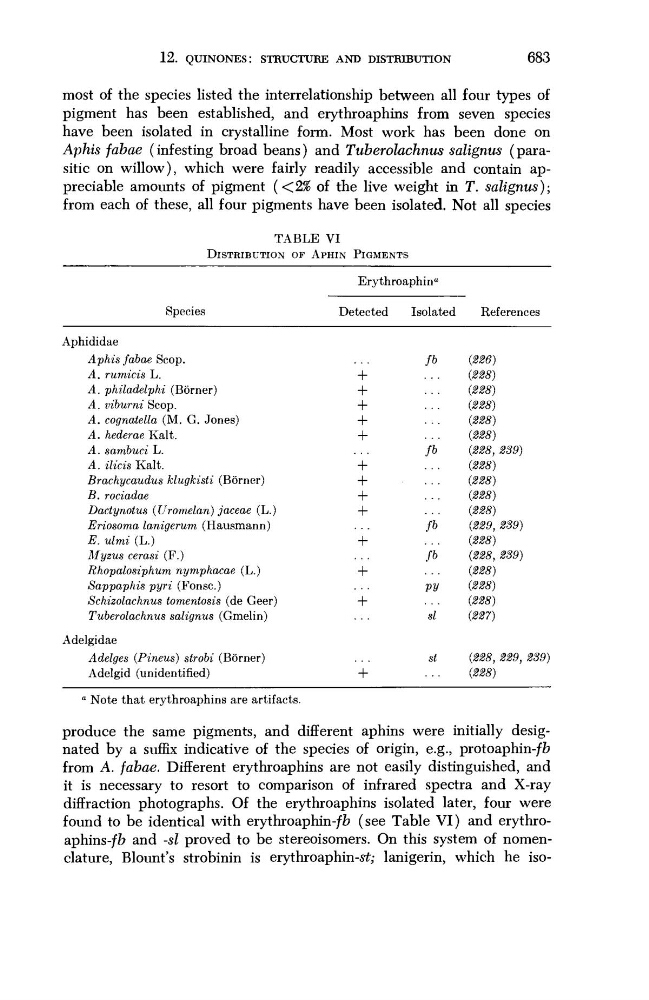
TABLE VI
DISTRIBUTION OF APHIN PIGMENTS
Species
Aphididae
Aphis fabae Scop.
A. rumicis L.
A. philadelphi (Börner)
A. viburni Scop.
A. cognatella (M. G. Jones)
A. hederae Kalt.
A. sambuci L.
A. ilicis Kalt.
Brachycaudus klugkisti (Börner)
B. rociadae
Dactynotus (Uromelan) jaceae (L.)
Eriosoma lanigerum (Hausmann)
E. ulmi (L.)
Myzus cerasi (F.)
Rhopalosiphum nymphacae (L.)
Sappaphis pyri (Fonsc.)
Schizolachnus tomentosis (de Geer)
Tuberolachnus salignus (Gmelin)
Erythroaphin
a
Detected
+
+
+
+
+
+
+
+
+
+
+
+
Isolated
ß
ß
ß
ß
py
si
References
{226)
(228)
(228)
(228)
(228)
(228)
(228, 239)
(228)
(228)
(228)
(228)
(229, 239)
(228)
(228, 239)
(228)
(228)
(228)
(227)
Adelgidae
Adelges (Pineus) strobi (Börner)
Adelgid (unidentified)
+
a Note that erythroaphins are artifacts.
produce the same pigments, and different aphins were initially designated by a suffix indicative of the species of origin, e.g., protoaphin-/b
from A. fabae. Different erythroaphins are not easily distinguished, and
it is necessary to resort to comparison of infrared spectra and X-ray
diffraction photographs. Of the erythroaphins isolated later, four were
found to be identical with erythroaphin-/& (see Table VI) and erythroaphins-ffo and -si proved to be stereoisomers. On this system of nomenclature, Blount's strobinin is erythroaphin-sf; lanigerin, which he isost
(228, 229, 239)
(228)