

662
R. H. THOMSON
Fungal Anthraquinone s a (continued)
In Aspergillus
MeO
1
O
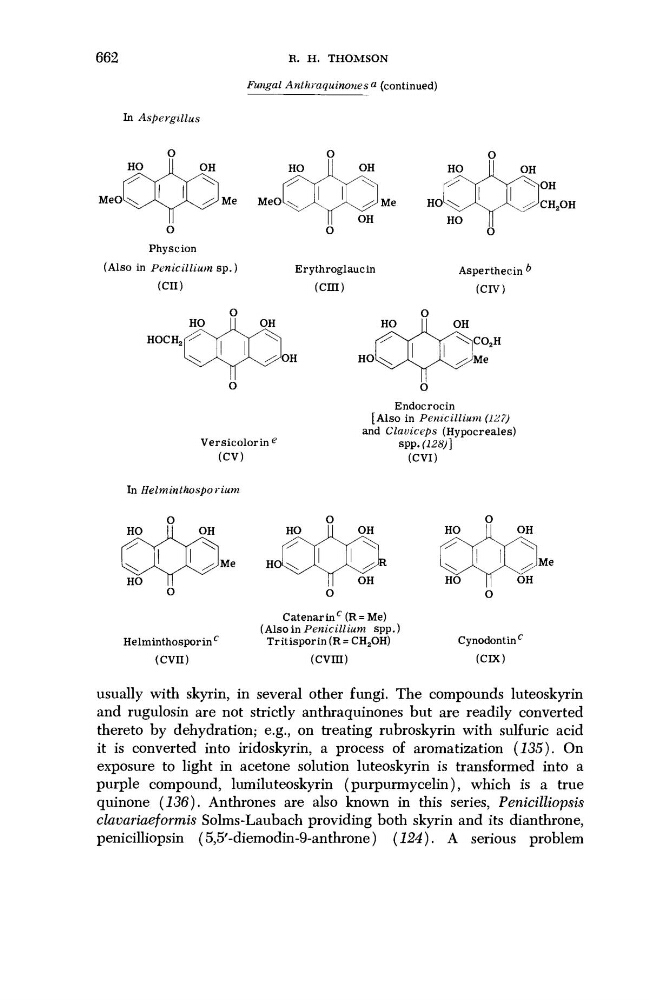
Physcion
(Also in Penicillium sp.)
(CII)
HOCH.
Me
HO
1
Erythroglaucin
(cm)
Asperthecin *
(CIV)
Versicolorin
e
(CV)
Endocrocin
[Also in Penicillium (127)
and Claviceps (Hypocreales)
Bpp.(128)]
(CVI)
In Helminthosporium
O
Helminthospor in
c
(CVII)
Catenarin
c (R = Me)
(Also in Penicillium spp.)
Tr itisporin (R = CH 2 OH)
(CVIII)
Cynodontin
c
(CDC)
usually with skyrin, in several other fungi. The compounds luteoskyrin
and rugulosin are not strictly anthraquinones but are readily converted
thereto by dehydration; e.g., on treating rubroskyrin with sulfuric acid
it is converted into iridoskyrin, a process of aromatization (135). On
exposure to light in acetone solution luteoskyrin is transformed into a
purple compound, lumiluteoskyrin (purpurmycelin), which is a true
quinone (136). Anthrones are also known in this series, Penicilliopsis
clavariaeformis Solms-Laubach providing both skyrin and its dianthrone,
penicilliopsin (5,5'-diemodin-9-anthrone) (124). A serious problem