

12. QUINONES: STRUCTURE AND DISTRIBUTION
Fungal Anthraquinones
a
(continued)
663
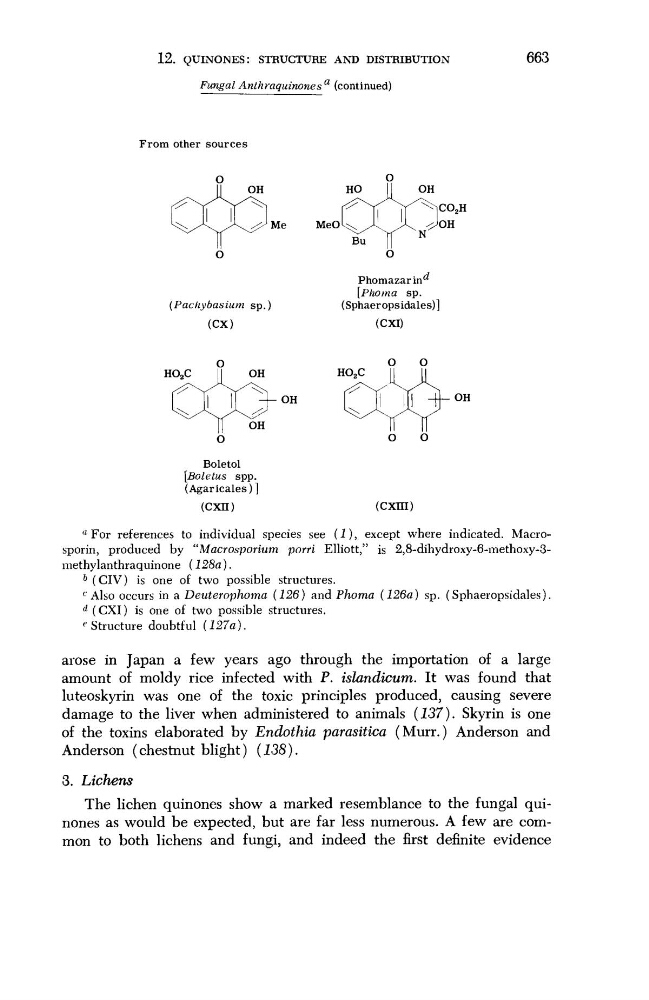
From other sources
MeO
(Pachybasium sp.)
(CX)
Phomazarin^
[Phoma sp.
(Sphaeropsidales)]
(CXI)
HOoC
HO z C
OH
OH
Boletol
[Boletus spp.
(Agaricales) ]
(CXII)
(cxm)
a For references to individual species see (I), except where indicated. Macrosporin, produced by "Macrosporium
porri Elliott," is 2,8-dihydroxy-6-methoxy-3methylanthraquinone (128a).
b (CIV) is one of two possible structures.
c Also occurs in a Deuterophoma (126) and Phoma (126a) sp. (Sphaeropsidales).
d (CXI) is one of two possible structures.
e Structure doubtful
(127a).
arose in Japan a few years ago through the importation of a large
amount of moldy rice infected with P. islandicum. It was found that
luteoskyrin was one of the toxic principles produced, causing severe
damage to the liver when administered to animals (137). Skyrin is one
of the toxins elaborated by Endothia parasitica (Murr.) Anderson and
Anderson (chestnut blight) (138).
3. Lichens
The lichen quinones show a marked resemblance to the fungal quinones as would be expected, but are far less numerous. A few are common to both lichens and fungi, and indeed the first definite evidence