

12. QUINONES: STRUCTURE AND DISTRIBUTION
661
In Penicillium
Fungal Anthraquinones
a
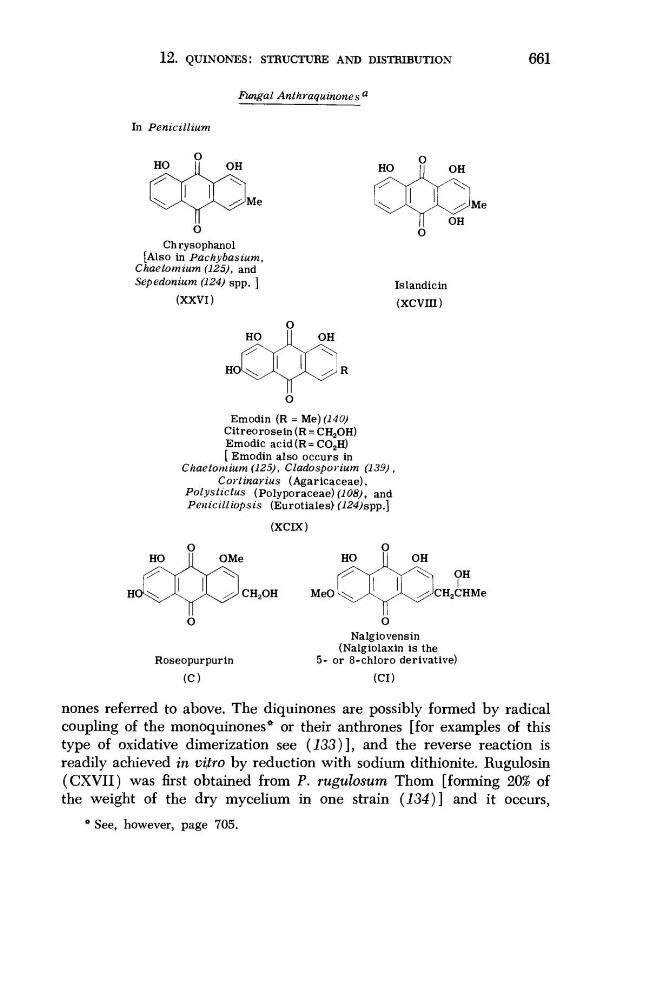
Chrysophanol
[Also in Pachybasium,
Chaetomium (125), and
Sepedonium (124) spp. ]
(XXVI)
Islandicin
(XCVIH)
Emodin (R = Me) (140)
Citreorosein (R = CH 2 OH)
Emodic acid(R=C0 2 H)
[ Emodin also occurs in
Chaetomium (125), Cladosporium (139) ,
Cortinarius (Agaricaceae),
Polystictus (Polyporaceae) (108), and
Penicilliopsis
(Eurotiales) (124)spp.]
(XCIX)
OMe
CH 2 OH
Roseopurpurin
(C)
MeO
O
Nalgiovensin
(Nalgiolaxin is the
5- or 8-chloro derivative)
(ci)
nones referred to above. The diquinones are possibly formed by radical
coupling of the monoquinones* or their anthrones [for examples of this
type of oxidative dimerization see (133)], and the reverse reaction is
readily achieved in vitro by reduction with sodium dithionite. Rugulosin
(CXVII) was first obtained from P. rugulosum Thorn [forming 20% of
the weight of the dry mycelium in one strain (134)] and it occurs,
* See, however, page 705.