

642
R. H. THOMSON
with any of the foregoing emodin-producing plants, but fagopyrin (17),
which is a derivative of hypericin, occurs in the flowers of buckwheat
(Fagopyrum esculentum Moench), a member of the Polygonaceae.
As noted above, emodin-type athraquinones frequently occur as
mixtures of related compounds, and this is usually the case in the
Rubiaceae. Small amounts of unidentified quinones are often isolated in
addition to the principal coloring matters (18). From the roots of the
madder plant (Rubia tinctorum Linn.), formerly a very important
natural dyestuff, the following quinones have been isolated: alizarin
(VIII), xanthopurpurin (X), rubiadin (XI), munjistin (XIV), purpurin
(XVI), and pseudopurpurin (XVII). The bark of the New Zealand
shrub Coprosma acerosa A. Cunn, used by the Maoris for dyeing
purposes, contains 3-hydroxy-2-methylanthraquinone (VII), rubiadin
methyl ether (XI), lucidin (XII), soranjidiol (XVIII), anthragallol 2methyl ether and 1,2-dimethyl ether (XV). Occasionally these pigments
occur in substantial amounts, as in the bark of Coprosma australis Robinson, of which morindone (XIX) and its glycoside morindin, together
with rubiadin 1-methyl ether constitute 17% of the dry weight, besides
minor constituents (19). On the other hand, there are several records
of the solitary occurrence of an anthraquinone in various plants unaccompanied by other anthracene compounds, e.g., chrysophanol in Saxifraga delavayi Franch (Saxifragaceae) (20) and alizarin in Hedyotis
auricularia (Rubiaceae) (21); digitolutein (XXIV) is the lone anthraquinone in the leaves of two Digitalis spp. (Scrophulariaceae) (22).
(2). Phenanthrenequinones.
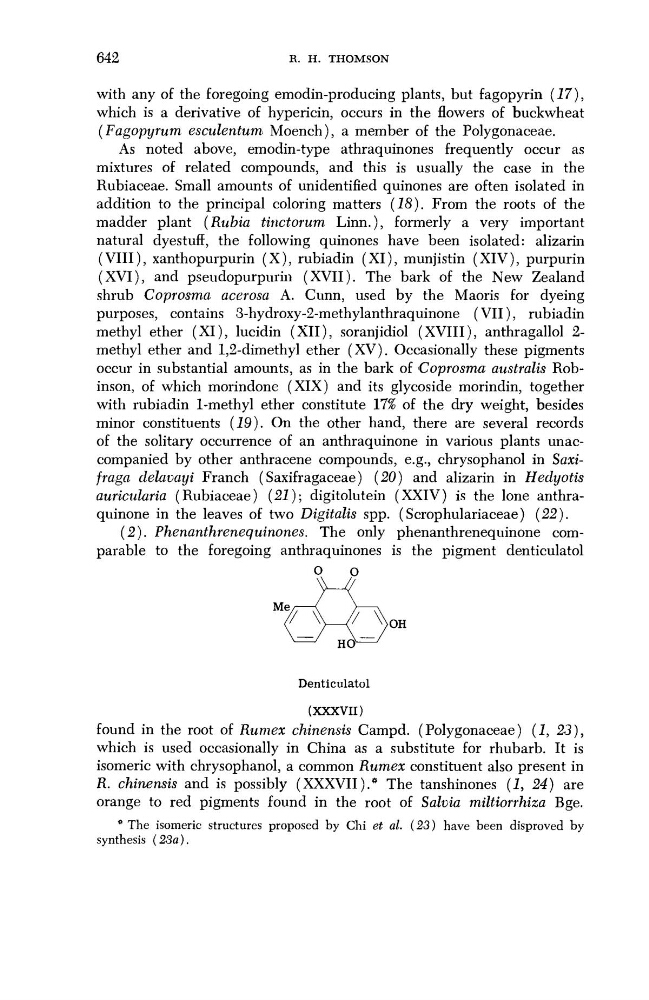
The only phenanthrenequinone comparable to the foregoing anthraquinones is the pigment denticulatol
Denticulatol
(XXXVII)
found in the root of Rumex chinensis Campd. (Polygonaceae) (1, 23),
which is used occasionally in China as a substitute for rhubarb. It is
isomeric with chrysophanol, a common Rumex constituent also present in
R. chinensis and is possibly (XXXVII).* The tanshinones (1, 24) are
orange to red pigments found in the root of Salvia miltiorrhiza Bge.
* The isomeric structures proposed by Chi et al. (23) have been disproved by
synthesis (23a).