

12. QUINONES: STRUCTURE AND DISTRIBUTION
641
O
HO II OH
k^\^^^ CH 2 OH
H l/H
C
1
H—C— OH
i
I
HO—C—H
O
I
I
H—C—OH
H—C
'
I
CH 2 OH
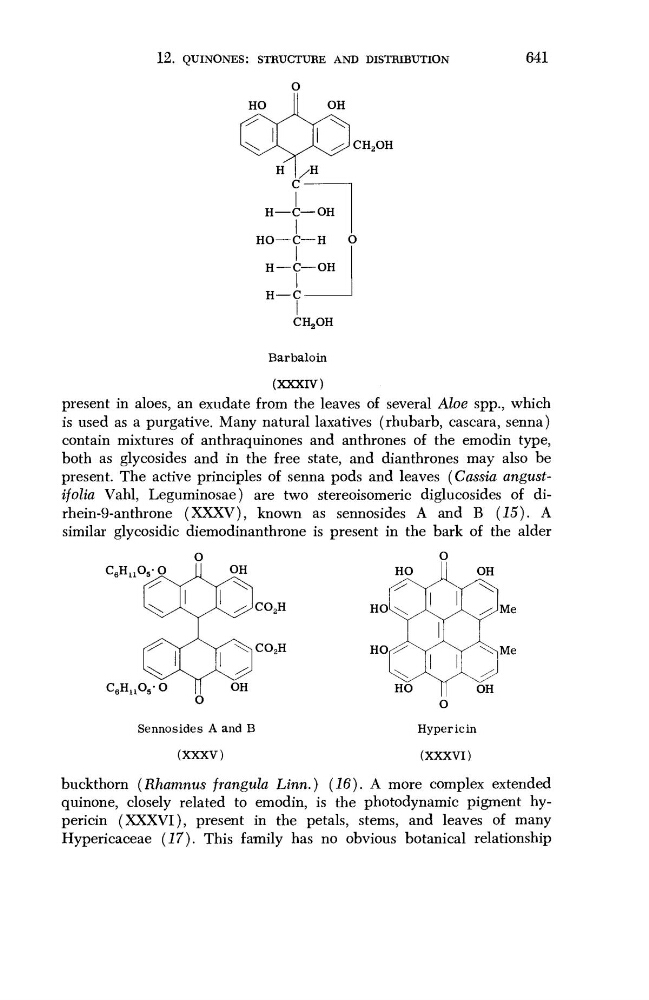
Barbaloin
(XXXIV)
present in aloes, an exudate from the leaves of several Aloe spp., which
is used as a purgative. Many natural laxatives (rhubarb, cascara, senna)
contain mixtures of anthraquinones and anthrones of the emodin type,
both as glycosides and in the free state, and dianthrones may also be
present. The active principles of senna pods and leaves (Cassia angustifolia Vahl, Leguminosae) are two stereoisomeric diglucosides of dirhein-9-anthrone (XXXV), known as sennosides A and B (15). A
similar glycosidic diemodinanthrone is present in the bark of the alder
O
O
Sennosides A and B
Hypericin
(XXXV)
(XXXVI)
buckthorn (Rhamnus frangula Linn.) (16). A more complex extended
quinone, closely related to emodin, is the photodynamic pigment hypericin (XXXVI), present in the petals, stems, and leaves of many
Hypericaceae (17). This family has no obvious botanical relationship