

640
R. H. THOMSON
together with emodin, and both of these, and/or related quinones, are
known in fungi and lichens. In contrast, none of the quinones produced
by the Rubiaceae have been found elsewhere with the exception of
3-hydroxy-2-methylanthraquinone (VII) which is present in teak
wood (Verbenaceae) (11) along with 2-methylanthraquinone. Quinones
of the emodin group are sometimes accompanied by the corresponding
anthrones, both in flowering plants and in fungi, and occasionally only
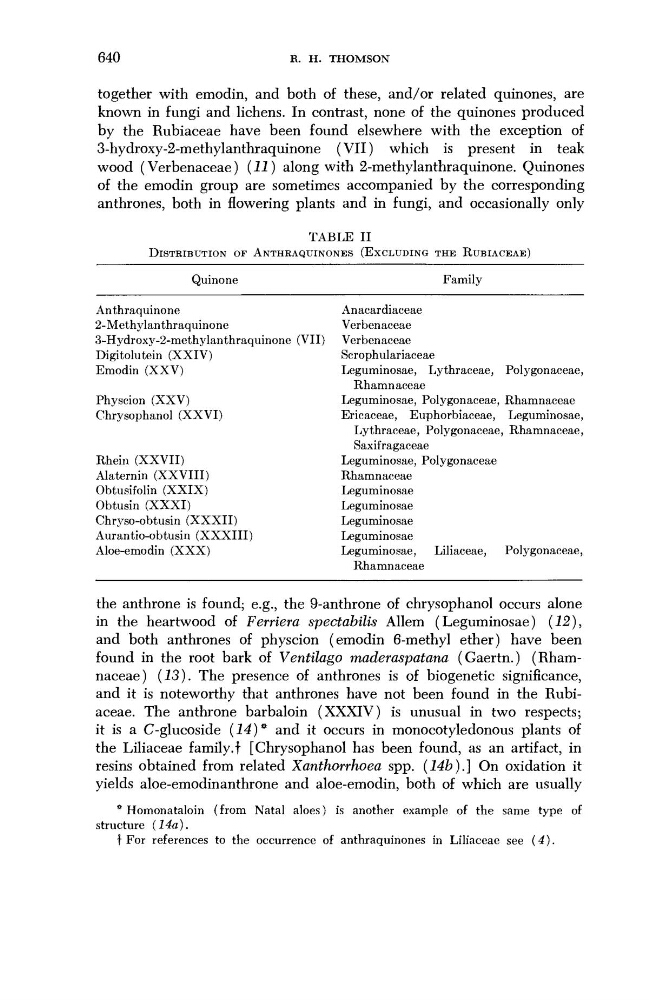
TABLE II
DISTRIBUTION OF ANTHRAQUINONES (EXCLUDING THE RUBIACEAE)
Quinone
Family
Anthraquinone
Anacardiaceae
2-Methylanthraquinone
Verbenaceae
3-Hydroxy-2-methylanthraquinone (VII)
Verbenaceae
Digitolutein (XXIV)
Scrophulariaceae
Emodin (XXV)
Leguminosae, Lythraceae, Polygonaceae,
Rhamnaceae
Physcion (XXV)
Leguminosae, Polygonaceae, Rhamnaceae
Chrysophanol (XXVI)
Ericaceae, Euphorbiaceae, Leguminosae,
Lythraceae, Polygonaceae, Rhamnaceae,
Saxifragaceae
Rhein (XXVII)
Leguminosae, Polygonaceae
Alaternin (XXVIII)
Rhamnaceae
Obtusifolin (XXIX)
Leguminosae
Obtusin (XXXI)
Leguminosae
Chryso-obtusin (XXXII)
Leguminosae
Aurantio-obtusin (XXXIII)
Leguminosae
Aloe-emodin (XXX)
Leguminosae,
Liliaceae,
Polygonaceae,
Rhamnaceae
the anthrone is found; e.g., the 9-anthrone of chrysophanol occurs alone
in the heartwood of Ferriera spectabilis Allem (Leguminosae) (12),
and both anthrones of physcion (emodin 6-methyl ether) have been
found in the root bark of Ventüago maderaspatana (Gaertn.) (Rhamnaceae) (13). The presence of anthrones is of biogenetic significance,
and it is noteworthy that anthrones have not been found in the Rubiaceae. The anthrone barbaloin (XXXIV) is unusual in two respects;
it is a C-glucoside (14)* and it occurs in monocotyledonous plants of
the Liliaceae family.f [Chrysophanol has been found, as an artifact, in
resins obtained from related Xanthorrhoea spp. (14b).] On oxidation it
yields aloe-emodinanthrone and aloe-emodin, both of which are usually
* Homonataloin (from Natal aloes) is another example of the same type of
structure (14a).
f For references to the occurrence of anthraquinones in Liliaceae see (4).