

12. QUINONES: STRUCTURE AND DISTRIBUTION
643
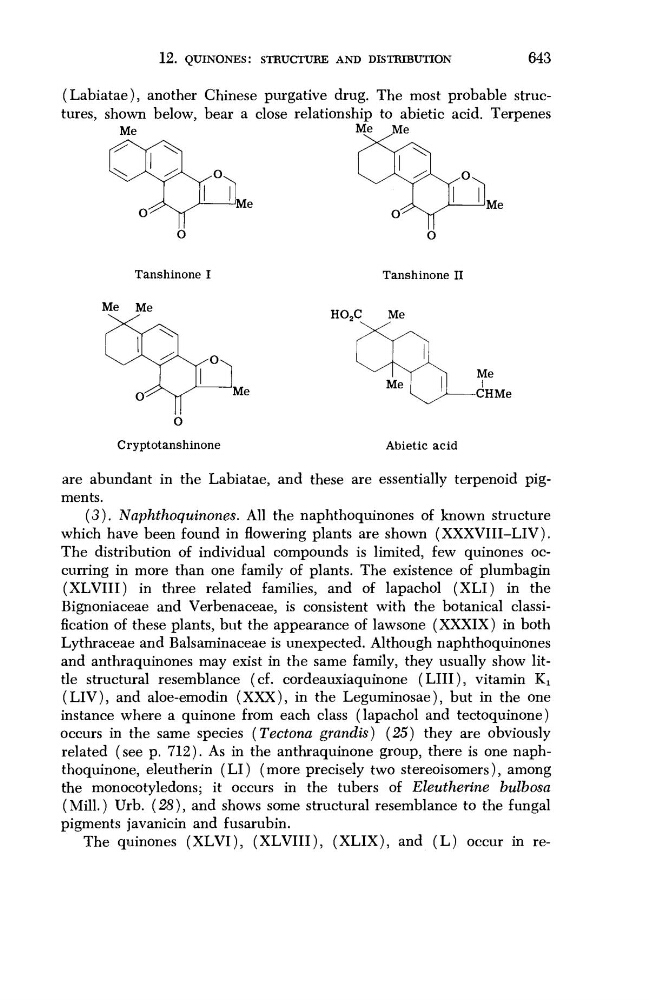
(Labiatae), another Chinese purgative drug. The most probable structures, shown below, bear a close relationship to abietic acid. Terpenes
Me
Me
Me
Me
Tanshinone I
Me Me
Tanshinone II
H0 2 C
Me
C ryptotanshinone
Abietic acid
are abundant in the Labiatae, and these are essentially terpenoid pigments.
(3). Naphthoquinones. All the naphthoquinones of known structure
which have been found in flowering plants are shown (XXXVIII-LIV).
The distribution of individual compounds is limited, few quinones occurring in more than one family of plants. The existence of plumbagin
(XLVIII) in three related families, and of lapachol (XLI) in the
Bignoniaceae and Verbenaceae, is consistent with the botanical classification of these plants, but the appearance of lawsone (XXXIX) in both
Lythraceae and Balsaminaceae is unexpected. Although naphthoquinones
and anthraquinones may exist in the same family, they usually show little structural resemblance (cf. cordeauxiaquinone (LIII), vitamin Κχ
(LIV), and aloe-emodin (XXX), in the Leguminosae), but in the one
instance where a quinone from each class (lapachol and tectoquinone)
occurs in the same species (Tectona grandis) (25) they are obviously
related (see p. 712). As in the anthraquinone group, there is one naphthoquinone, eleutherin (LI) (more precisely two stereoisomers), among
the monocotyledons; it occurs in the tubers of Eleutherine bulbosa
(Mill.) Urb. (28), and shows some structural resemblance to the fungal
pigments javanicin and fusarubin.
The quinones (XLVI), (XLVIII), (XLIX), and (L) occur in re-