

11. TERPENOIDS: METABOLISM
613
These reactions also play a great part in the biogenesis of many
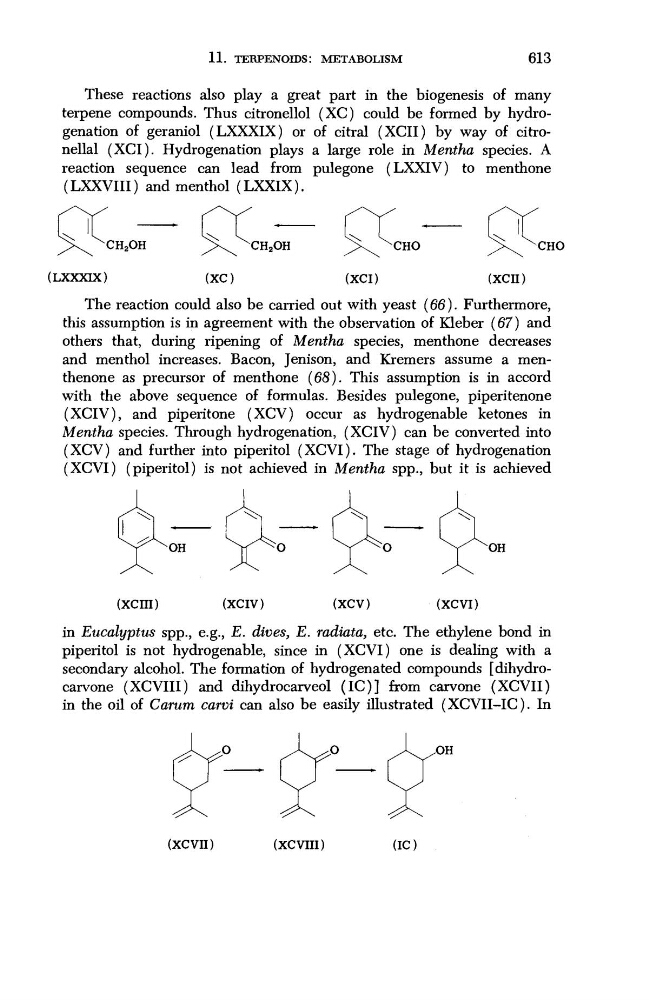
terpene compounds. Thus citronellol (XC) could be formed by hydrogenation of geraniol (LXXXIX) or of citral (XCII) by way of citronellal (XCI). Hydrogenation plays a large role in Mentha species. A
reaction sequence can lead from pulegone (LXXIV) to menthone
(LXXVIII) and menthol (LXXIX).
CH 2 OH
CH s OH
CHO
CHO
(LXXXIX)
(XC)
(XCI)
(XCII)
The reaction could also be carried out with yeast (66). Furthermore,
this assumption is in agreement with the observation of Kleber (67) and
others that, during ripening of Mentha species, menthone decreases
and menthol increases. Bacon, Jenison, and Kremers assume a menthenone as precursor of menthone (68). This assumption is in accord
with the above sequence of formulas. Besides pulegone, piperitenone
(XCIV), and piperitone (XCV) occur as hydrogenable ketones in
Mentha species. Through hydrogenation, (XCIV) can be converted into
(XCV) and further into piperitol (XCVI). The stage of hydrogenation
(XCVI) (piperitol) is not achieved in Mentha spp., but it is achieved
(XCIII)
(XCIV)
(XCV)
(XCVI)
in Eucalyptus spp., e.g., E. dives, E. radiata, etc. The ethylene bond in
piperitol is not hydrogenable, since in (XCVI) one is dealing with a
secondary alcohol. The formation of hydrogenated compounds [dihydrocarvone (XCVIII) and dihydrocarveol (IC)] from carvone (XCVII)
in the oil of Carum carvi can also be easily illustrated (XCVII-IC). In
(XCVII)
(XCVIII)
(IC)