

614
W. SANDERMANN
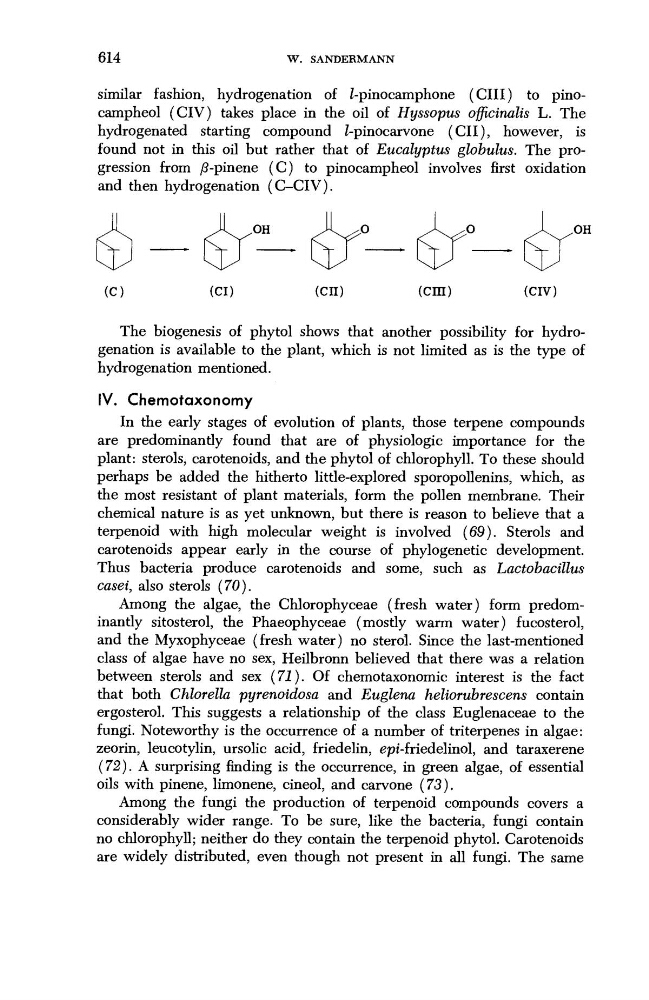
similar fashion, hydrogenation of Z-pinocamphone (CIII) to pinocampheol (CIV) takes place in the oil of Hyssopus officinalis L. The
hydrogenated starting compound Z-pinocarvone (CII), however, is
found not in this oil but rather that of Eucalyptus globulus. The progression from ß-pinene (C) to pinocampheol involves first oxidation
and then hydrogenation (C-CIV).
6 - &~- έτ*- fr- έτ
(c)
(ci)
(cii)
(era)
(civ)
The biogenesis of phytol shows that another possibility for hydrogenation is available to the plant, which is not limited as is the type of
hydrogenation mentioned.
IV. Chemotaxonomy
In the early stages of evolution of plants, those terpene compounds
are predominantly found that are of physiologic importance for the
plant: sterols, carotenoids, and the phytol of chlorophyll. To these should
perhaps be added the hitherto little-explored sporopollenins, which, as
the most resistant of plant materials, form the pollen membrane. Their
chemical nature is as yet unknown, but there is reason to believe that a
terpenoid with high molecular weight is involved (69). Sterols and
carotenoids appear early in the course of phylogenetic development.
Thus bacteria produce carotenoids and some, such as Lactobacillus
casei, also sterols (70).
Among the algae, the Chlorophyceae (fresh water) form predominantly sitosterol, the Phaeophyceae (mostly warm water) fucosterol,
and the Myxophyceae (fresh water) no sterol. Since the last-mentioned
class of algae have no sex, Heilbronn believed that there was a relation
between sterols and sex (71). Of chemotaxonomic interest is the fact
that both Chlorella pyrenoidosa and Euglena heliorubrescens contain
ergosterol. This suggests a relationship of the class Euglenaceae to the
fungi. Noteworthy is the occurrence of a number of triterpenes in algae:
zeorin, leucotylin, ursolic acid, friedelin, epi-friedelinol, and taraxerene
(72). A surprising finding is the occurrence, in green algae, of essential
oils with pinene, limonene, cineol, and carvone (73).
Among the fungi the production of terpenoid compounds covers a
considerably wider range. To be sure, like the bacteria, fungi contain
no chlorophyll; neither do they contain the terpenoid phytol. Carotenoids
are widely distributed, even though not present in all fungi. The same