

612
W. SANDERMANN
TABLE III
OCCURRENCE OF FURANIC COMPOUNDS (C2) WITH TERPENOID CHAINS (C5-CI5)
Family
Umbelliferae
Species
Angelica archangelica
Imperatoria ostruthium
Ammi visnaga
c 2
+
+
c 5
+
+
+
C2—C5
+
+
C10
+
C15
+
Rutaceae
Xanthopylum
flavum
+
+
Xanthoxylum rhetsa
+
+
Skimmia japonica
+
+
Aegle marmelos
+
+
Casimiroa edulis
+
Flindersia species
+
+
Leguminosae
Derris elliptica
+
+
Pachyrrhizus erosus
+
+
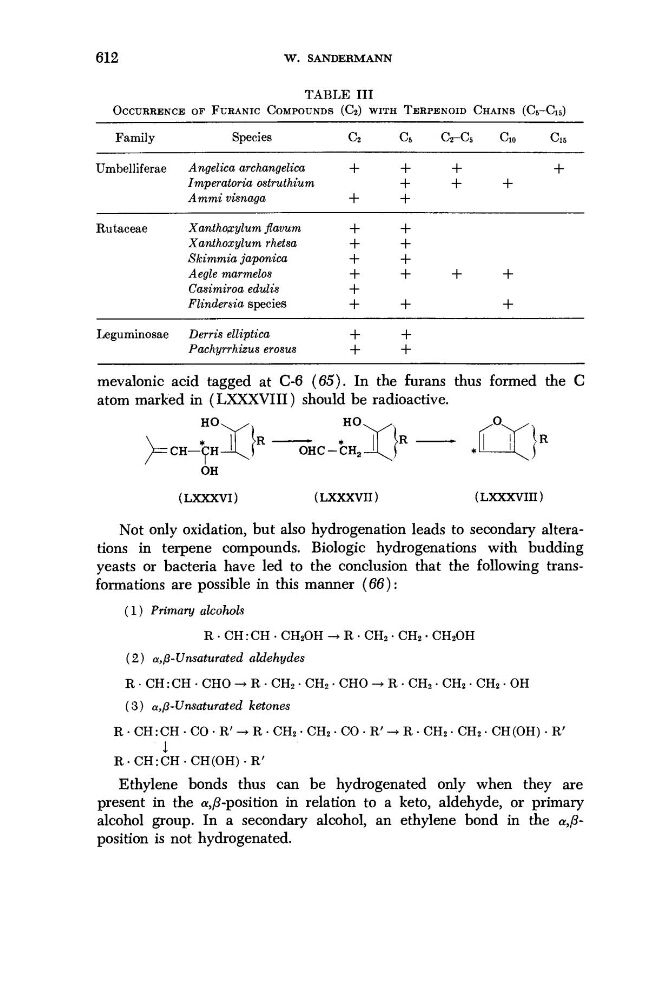
mevalonic acid tagged at C-6 (65). In the furans thus formed the C
atom marked in (LXXXVIII) should be radioactive.
\
* Y}R —» * V"1R —. if Y")R
>=CH—CH-iJ^|
OHC-CH2-AJ
*U
U^J
OH
(LXXXVI)
(LXXXVII)
(LXXXVIII)
Not only oxidation, but also hydrogenation leads to secondary alterations in terpene compounds. Biologic hydrogenations with budding
yeasts or bacteria have led to the conclusion that the following transformations are possible in this manner (66):
(1) Primary ahohols
R · CH: CH · CH 2 OH -> R · CH 2 · CH 2 · CH 2 OH
(2) a,ß-Umaturated
aldehydes
R · CH:CH · CHO -> R · CH 2 · CH 2 · CHO -> R · CH 2 · CH 2 . CH 2 · OH
(3) a,ß'Umaturated
ketones
R · CH:CH · CO · R' -^ R · CH 2 · CH 2 · CO · R' -> R · CH 2 · CH 2 · CH(OH) · R'
i
R-CH:CH-CH(OH)-R'
Ethylene bonds thus can be hydrogenated only when they are
present in the α,β-position in relation to a keto, aldehyde, or primary
alcohol group. In a secondary alcohol, an ethylene bond in the apposition is not hydrogenated.
+
+
+