

11. TERPENOIDS: METABOLISM
611
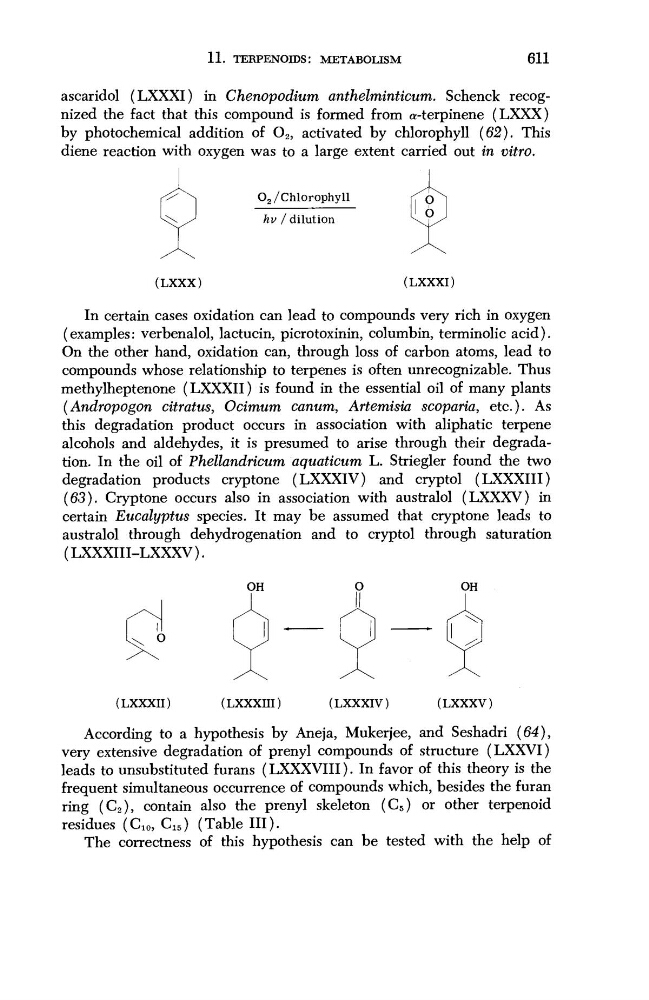
ascaridol (LXXXI) in Chenopodium anthelminticum. Schenck recognized the fact that this compound is formed from α-terpinene (LXXX)
by photochemical addition of 0 2 , activated by chlorophyll (62). This
diene reaction with oxygen was to a large extent carried out in vitro.
0 2 /Chlorophyll
hv I dilution
(LXXX)
(LXXXI)
In certain cases oxidation can lead to compounds very rich in oxygen
(examples: verbenalol, lactucin, picrotoxinin, columbin, terminolic acid).
On the other hand, oxidation can, through loss of carbon atoms, lead to
compounds whose relationship to terpenes is often unrecognizable. Thus
methylheptenone (LXXXII) is found in the essential oil of many plants
(Andropogon citratus, Ocimum canum, Artemisia scoparia, etc.). As
this degradation product occurs in association with aliphatic terpene
alcohols and aldehydes, it is presumed to arise through their degradation. In the oil of Phellandricum aquaticum L. Striegler found the two
degradation products cryptone (LXXXIV) and cryptol (LXXXIII)
(63). Cryptone occurs also in association with australol (LXXXV) in
certain Eucalyptus species. It may be assumed that cryptone leads to
australol through dehydrogenation and to cryptol through saturation
(LXXXIII-LXXXV).
(LXXXII)
(LXXXIII)
(LXXXI V)
(LXXXV)
According to a hypothesis by Aneja, Mukerjee, and Seshadri (64),
very extensive degradation of prenyl compounds of structure (LXXVI)
leads to unsubstituted furans (LXXXVIII). In favor of this theory is the
frequent simultaneous occurrence of compounds which, besides the furan
ring (C 2 ), contain also the prenyl skeleton (C 5 ) or other terpenoid
residues (Ci 0 , Ci 5 ) (Table III).
The correctness of this hypothesis can be tested with the help of