

608
W. SANDERMANN
.OH
(Lvm)
(LDC)
(LX)
(LXI)
(LXII)
(LXin)
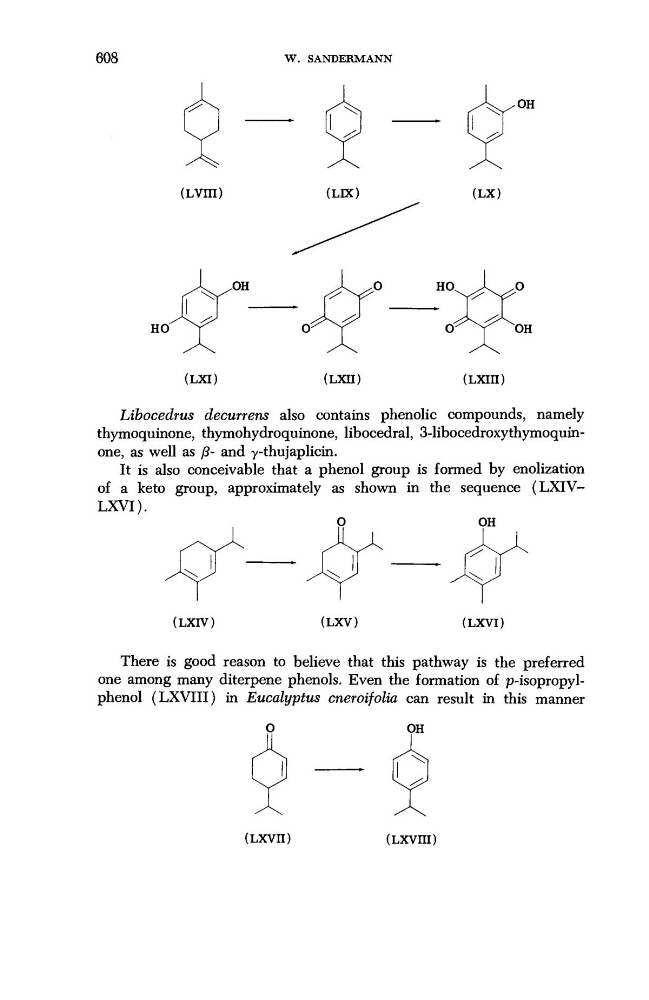
Libocedrus decurrens also contains phenolic compounds, namely
thymoquinone, thymohydroquinone, libocedral, 3-libocedroxythymoquinone, as well as ß- and γ-thujaplicin.
It is also conceivable that a phenol group is formed by enolization
of a keto group, approximately as shown in the sequence (LXIVLXVI).
O
OH
(LXIV)
(LXV)
(LXVI)
There is good reason to believe that this pathway is the preferred
one among many diterpene phenols. Even the formation of p-isopropylphenol (LXVIII) in Eucalyptus cneroifolia can result in this manner
(LXVn)
(LXVm)