

11. TERPENOIDS: METABOLISM
609
from a precursor that could arise from cryptone (LXVII), which occurs
in this oil.
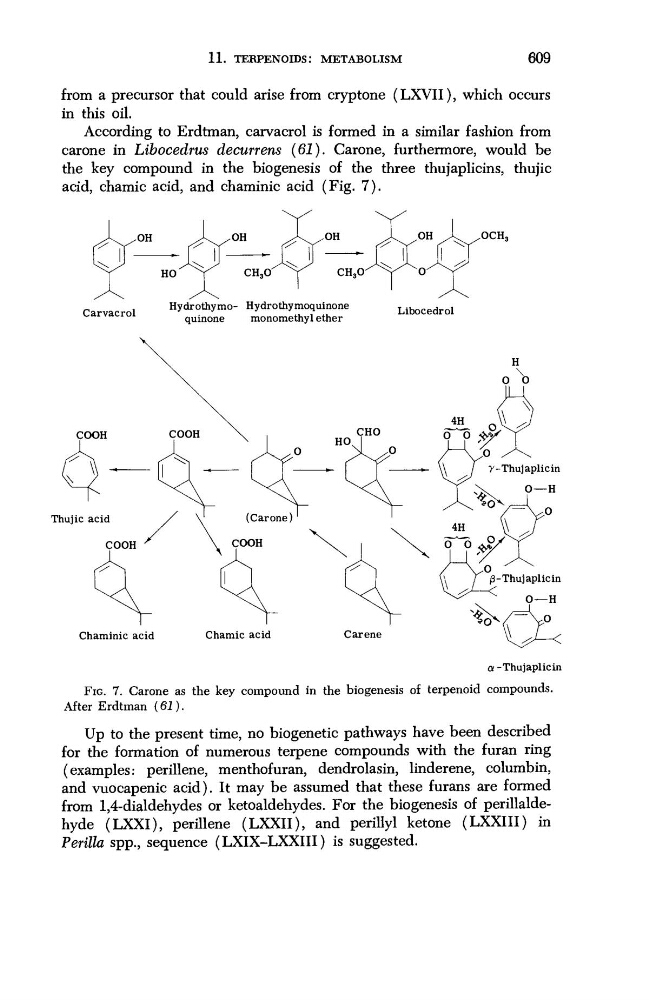
According to Erdtman, carvacrol is formed in a similar fashion from
carone in Libocedrus decurrens (61). Carone, furthermore, would be
the key compound in the biogenesis of the three thujaplicins, thujic
acid, chamic acid, and chaminic acid (Fig. 7).
a -Thujaplicin
FIG. 7. Carone as the key compound in the biogenesis of terpenoid compounds.
After Erdtman (61).
Up to the present time, no biogenetic pathways have been described
for the formation of numerous terpene compounds with the furan ring
(examples: perillene, menthofuran, dendrolasin, linderene, columbin,
and vuocapenic acid). It may be assumed that these furans are formed
from 1,4-dialdehydes or ketoaldehydes. For the biogenesis of perillaldehyde (LXXI), perillene (LXXII), and perillyl ketone (LXXIII) in
PerilL· spp., sequence (LXIX-LXXIII) is suggested.