

11. TERPENOIDS: METABOLISM
607
It can be seen in Table II that the aldehyde step occurs predominantly
among monoterpenes whereas the carboxyl step occurs among sesqui-,
di-, and triterpenes: In certain cases the carboxyl group may be split off,
thus achieving complete demethylation. Elimination of the three methyl
groups of squalene always occurs in the biogenesis of sterols. However,
a number of demethyltriterpenes are known as intermediates in which
only one methyl group has been removed, e.g., lophenol.
Oxidation reactions also include dehydrogenations. Examples of compounds arising in this manner are cosmene, safranol, cymol, ör-turmerone, calamenene, azulene, dehydroabietic acid, vitamin A, and tanshinone. Numerous phenols should also be mentioned here, such as
carvocrol, thymol, the thujaplicins, thymohydroquinone and its derivatives, ferruginol, hinokiol, totarol, nimbiol, podocarpic acid, xanthoperol,
and gossypol.
The formation of phenols can take place by direct oxidation of an
aromatic ring. Thus phenylpyruvic acid is converted in the animal to
3,4-dihydroxyphenylalanine (the precursor of adrenaline) and in the
plant to coniferyl alcohol (the precursor of lignin). In each case, the
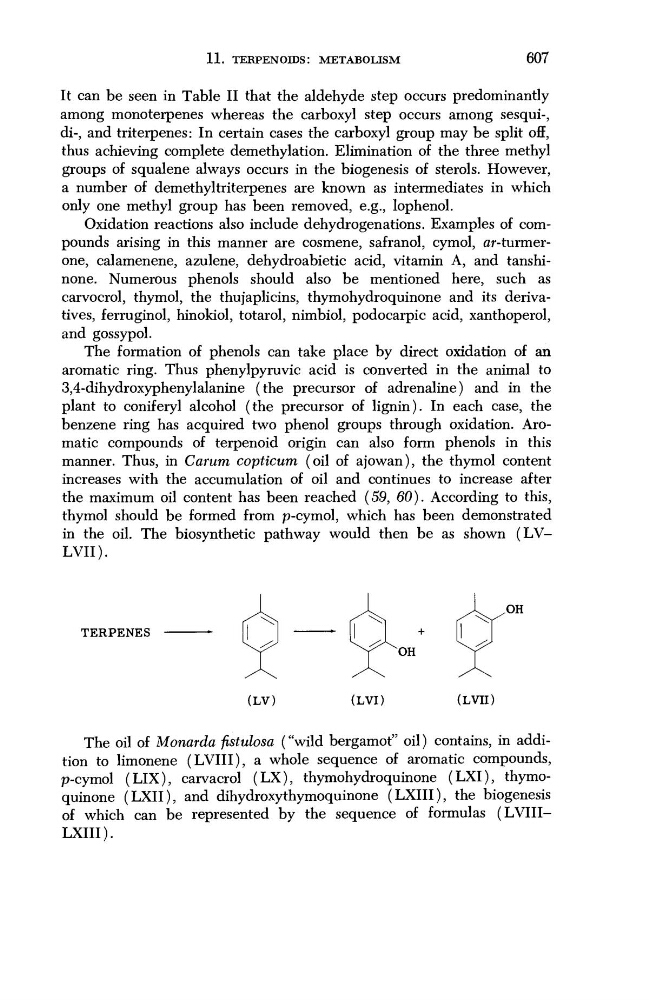
benzene ring has acquired two phenol groups through oxidation. Aromatic compounds of terpenoid origin can also form phenols in this
manner. Thus, in Carum copticum (oil of ajowan), the thymol content
increases with the accumulation of oil and continues to increase after
the maximum oil content has been reached (59, 60). According to this,
thymol should be formed from p-cymol, which has been demonstrated
in the oil. The biosynthetic pathway would then be as shown (LVLVII).
TERPENES
(LV)
(LVI)
(LVII)
The oil of Monarda fistulosa ("wild bergamot" oil) contains, in addition to limonene (LVIII), a whole sequence of aromatic compounds,
p-cymol (LIX), carvacrol (LX), thymohydroquinone (LXI), thymoquinone (LXII), and dihydroxythymoquinone (LXIII), the biogenesis
of which can be represented by the sequence of formulas (LVIIILXIII).