

11. TERPENOIDS: METABOLISM
603
One of the most important problems in the oxidation of terpenes is
the formation of hydroxyl and keto groups in the vicinity of ethylene
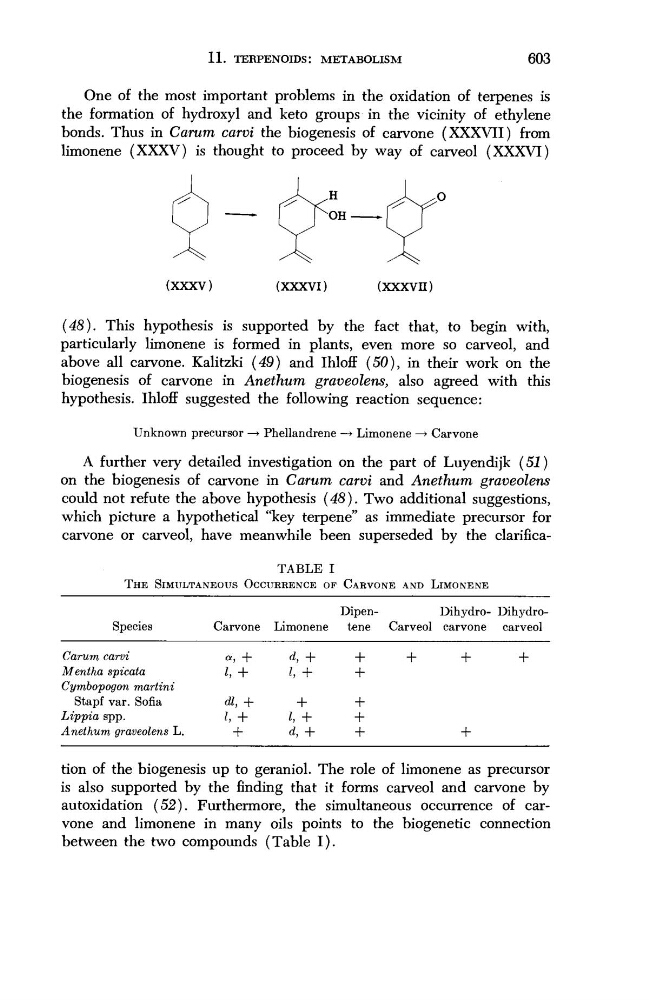
bonds. Thus in Carum carvi the biogenesis of carvone (XXXVII) from
limonene (XXXV) is thought to proceed by way of carveol (XXXVI)
(XXXV)
(XXXVI)
(XXXVII)
(48). This hypothesis is supported by the fact that, to begin with,
particularly limonene is formed in plants, even more so carveol, and
above all carvone. Kalitzki (49) and Ihloff (50), in their work on the
biogenesis of carvone in Anethum graveolens, also agreed with this
hypothesis. IhloflF suggested the following reaction sequence:
Unknown precursor —> Phellandrene —» Limonene —> Carvone
A further very detailed investigation on the part of Luyendijk (51)
on the biogenesis of carvone in Carum carvi and Anethum graveolens
could not refute the above hypothesis (48). Two additional suggestions,
which picture a hypothetical "key terpene" as immediate precursor for
carvone or carveol, have meanwhile been superseded by the clarificaTABLE I
THE SIMULTANEOUS OCCUBRENCE OF CARVONE AND LIMONENE
DipenDihydro- DihydroSpecies
Carvone Limonene
tene
Carveol carvone
carveol
+
+
+
Carum carvi
Mentha spicata
Cymbopogon martini
Stapf var. Sofia
Lippia spp.
Anethum graveolens L.
«, +
*, +
dl, +
I, +
+
d, +
I, +
+
I, +
d, +
+
+
+
+
+
+
tion of the biogenesis up to geraniol. The role of limonene as precursor
is also supported by the finding that it forms carveol and carvone by
autoxidation (52). Furthermore, the simultaneous occurrence of carvone and limonene in many oils points to the biogenetic connection
between the two compounds (Table I).