

602
W. SANDERMANN
biogenesis of lanosterol has been especially well explored, since this
triterpene is an intermediate in the biogenesis of sterols from squalene
(Chapter 3, this volume). Biogenetic investigations with tagged substances were carried out on eburicoic acid (41,42) and soysapogenols
(43). It was found that the reactions leading to triterpene are sterically
strictly controlled. With this, the biogenetic isoprene rule also receives
experimental support.
Interesting is a new type of triterpene with open ring A, e.g., in
dammarenolic acid and nyctanthic acid. It is possible that this type
arises through the cleavage of a ketone (44).
The position of the terpenoids in the framework of the total plant
biogenesis is shown in Fig. 6.
III. Biochemical Oxidations and Hydrogenations
The aliphatic primary products of terpene biogenesis—geraniol,
farnesol, geranylgeraniol, and squalene—as well as the combinations
arising therefrom by cyclization, can undergo many changes through
oxidation and reduction. The exact pathway of these biogenetic reactions
has, until recently, been elucidated only in a few cases.
Introduction of an OH group can be accomplished through direct
oxidation, through reduction of a keto or an aldehyde group, and
through hydration of an ethylene bond. Thus, for example, terpineol is
formed by hydration of limonene. That hydroxyl groups can be directly
introduced into terpene compounds in vivo was demonstrated by feeding
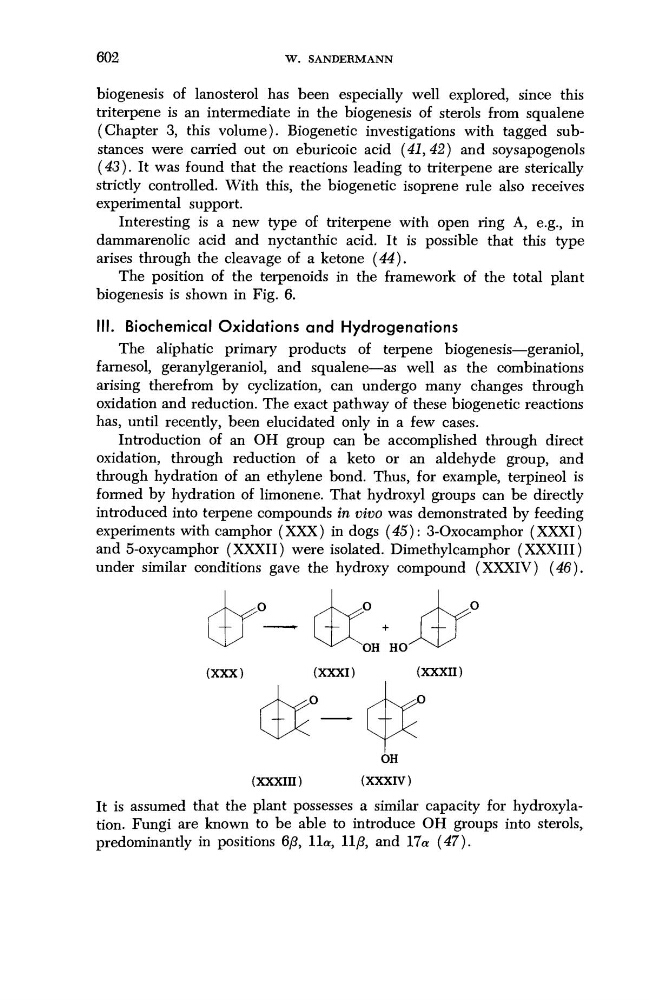
experiments with camphor (XXX) in dogs (45): 3-Oxocamphor (XXXI)
and 5-oxycamphor (XXXII) were isolated. Dimethylcamphor (XXXIII)
under similar conditions gave the hydroxy compound (XXXIV) (46).
O
O
(XXX)
ΌΗ HO"
(XXXI)
(XXXII)
o
(XXXIII)
OH
(XXXIV)
It is assumed that the plant possesses a similar capacity for hydroxylation. Fungi are known to be able to introduce OH groups into sterols,
predominantly in positions 6β, 11α, 11/?, and 17α (47).