

604
W. SANDERMANN
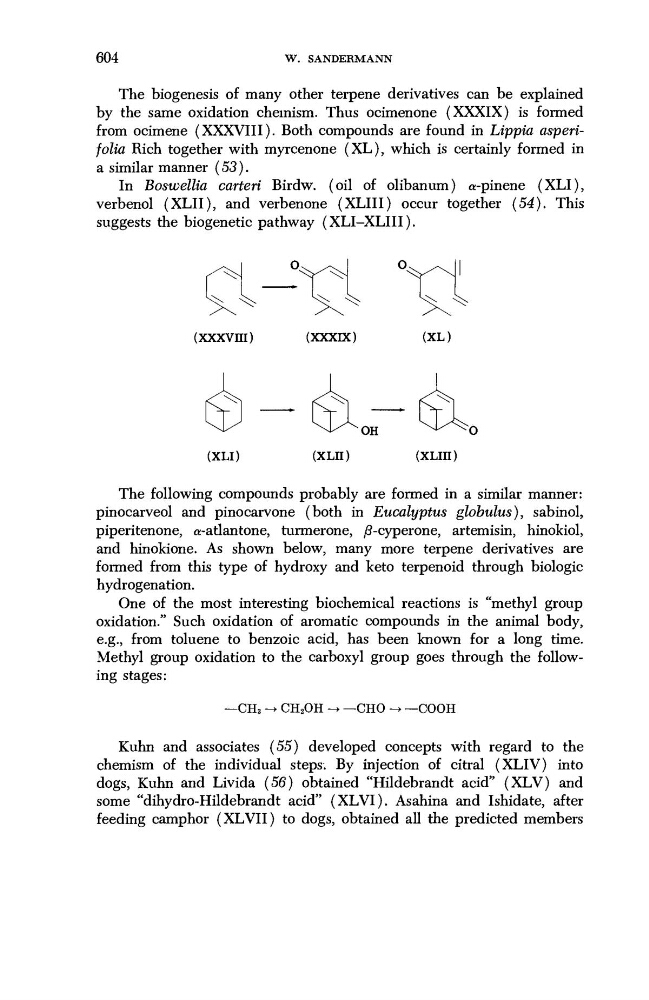
The biogenesis of many other terpene derivatives can be explained
by the same oxidation chemism. Thus ocimenone (XXXIX) is formed
from ocimene (XXXVIII). Both compounds are found in Lippia asperifolia Rich together with myrcenone (XL), which is certainly formed in
a similar manner (53).
In Boswellia carteri Birdw. (oil of olibanum) α-pinene (XLI),
verbenol (XLII), and verbenone (XLIII) occur together (54). This
suggests the biogenetic pathway (XLI-XLIII).
(XLI)
(XLII)
(XLIII)
The following compounds probably are formed in a similar manner:
pinocarveol and pinocarvone (both in Eucalyptus globulus), sabinol,
piperitenone, α-atlantone, turmerone, ß-cyperone, artemisin, hinokiol,
and hinokione. As shown below, many more terpene derivatives are
formed from this type of hydroxy and keto terpenoid through biologic
hydrogenation.
One of the most interesting biochemical reactions is "methyl group
oxidation." Such oxidation of aromatic compounds in the animal body,
e.g., from toluene to benzoic acid, has been known for a long time.
Methyl group oxidation to the carboxyl group goes through the following stages:
—CH 3 -> CH 2 OH -> —CHO -> —COOH
Kuhn and associates (55) developed concepts with regard to the
chemism of the individual steps. By injection of citral (XLIV) into
dogs, Kuhn and Livida (56) obtained "Hildebrandt acid" (XLV) and
some "dihydro-Hildebrandt acid" (XLVI). Asahina and Ishidate, after
feeding camphor (XLVII) to dogs, obtained all the predicted members