

9. SACCHARIDES: ALTERNATE ROUTES OF METABOLISM
491
D-mannitol and D-arabitol by the semen dehydrogenase may be due to
impurities in the polyols used. These enzymes thus are most probably
identical.
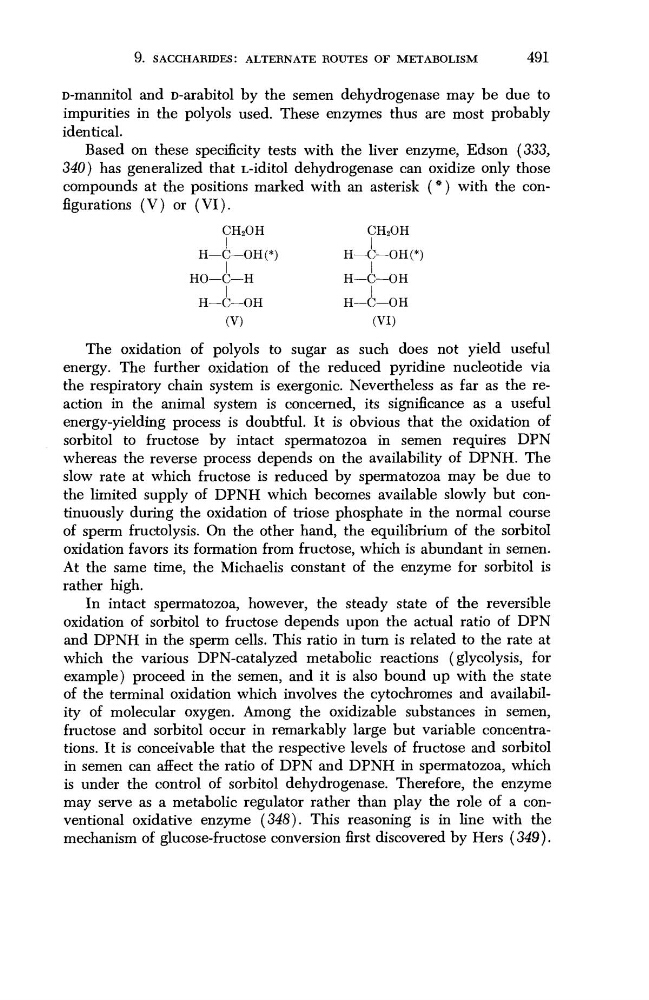
Based on these specificity tests with the liver enzyme, Edson (333,
340) has generalized that L-iditol dehydrogenase can oxidize only those
compounds at the positions marked with an asterisk (*) with the configurations (V) or (VI).
CH 2 OH
CH 2 OH
I
I
H—C—OH (*)
H—C—OH (*)
I
I
HO—C—H
H—C—OH
I
I
H—C—OH
H—C—OH
(V)
(VI)
The oxidation of polyols to sugar as such does not yield useful
energy. The further oxidation of the reduced pyridine nucleotide via
the respiratory chain system is exergonic. Nevertheless as far as the reaction in the animal system is concerned, its significance as a useful
energy-yielding process is doubtful. It is obvious that the oxidation of
sorbitol to fructose by intact spermatozoa in semen requires DPN
whereas the reverse process depends on the availability of DPNH. The
slow rate at which fructose is reduced by spermatozoa may be due to
the limited supply of DPNH which becomes available slowly but continuously during the oxidation of triose phosphate in the normal course
of sperm fructolysis. On the other hand, the equilibrium of the sorbitol
oxidation favors its formation from fructose, which is abundant in semen.
At the same time, the Michaelis constant of the enzyme for sorbitol is
rather high.
In intact spermatozoa, however, the steady state of the reversible
oxidation of sorbitol to fructose depends upon the actual ratio of DPN
and DPNH in the sperm cells. This ratio in turn is related to the rate at
which the various DPN-catalyzed metabolic reactions (glycolysis, for
example) proceed in the semen, and it is also bound up with the state
of the terminal oxidation which involves the cytochromes and availability of molecular oxygen. Among the oxidizable substances in semen,
fructose and sorbitol occur in remarkably large but variable concentrations. It is conceivable that the respective levels of fructose and sorbitol
in semen can affect the ratio of DPN and DPNH in spermatozoa, which
is under the control of sorbitol dehydrogenase. Therefore, the enzyme
may serve as a metabolic regulator rather than play the role of a conventional oxidative enzyme (348). This reasoning is in line with the
mechanism of glucose-fructose conversion first discovered by Hers (349).
491
D-mannitol and D-arabitol by the semen dehydrogenase may be due to
impurities in the polyols used. These enzymes thus are most probably
identical.
Based on these specificity tests with the liver enzyme, Edson (333,
340) has generalized that L-iditol dehydrogenase can oxidize only those
compounds at the positions marked with an asterisk (*) with the configurations (V) or (VI).
CH 2 OH
CH 2 OH
I
I
H—C—OH (*)
H—C—OH (*)
I
I
HO—C—H
H—C—OH
I
I
H—C—OH
H—C—OH
(V)
(VI)
The oxidation of polyols to sugar as such does not yield useful
energy. The further oxidation of the reduced pyridine nucleotide via
the respiratory chain system is exergonic. Nevertheless as far as the reaction in the animal system is concerned, its significance as a useful
energy-yielding process is doubtful. It is obvious that the oxidation of
sorbitol to fructose by intact spermatozoa in semen requires DPN
whereas the reverse process depends on the availability of DPNH. The
slow rate at which fructose is reduced by spermatozoa may be due to
the limited supply of DPNH which becomes available slowly but continuously during the oxidation of triose phosphate in the normal course
of sperm fructolysis. On the other hand, the equilibrium of the sorbitol
oxidation favors its formation from fructose, which is abundant in semen.
At the same time, the Michaelis constant of the enzyme for sorbitol is
rather high.
In intact spermatozoa, however, the steady state of the reversible
oxidation of sorbitol to fructose depends upon the actual ratio of DPN
and DPNH in the sperm cells. This ratio in turn is related to the rate at
which the various DPN-catalyzed metabolic reactions (glycolysis, for
example) proceed in the semen, and it is also bound up with the state
of the terminal oxidation which involves the cytochromes and availability of molecular oxygen. Among the oxidizable substances in semen,
fructose and sorbitol occur in remarkably large but variable concentrations. It is conceivable that the respective levels of fructose and sorbitol
in semen can affect the ratio of DPN and DPNH in spermatozoa, which
is under the control of sorbitol dehydrogenase. Therefore, the enzyme
may serve as a metabolic regulator rather than play the role of a conventional oxidative enzyme (348). This reasoning is in line with the
mechanism of glucose-fructose conversion first discovered by Hers (349).