

490
VERNON H. CHELDELIN, CHIH H. WANG, AND TSOO E. KING
However, raeso-erythritol, D- or L-arabitol, galactitol (dulcitol), Lglucitol (D-gulitol), 6-deoxy-L-gulitol, D-iditol, D-mannitol, D-talitol (Daltritol), and O-manno-O-gala-heptitol are not oxidized. It is believed
that these reactions are catalyzed by one enzyme. L-Iditol dehydrogenase
is the generic name given by Edson (333, 340), but the name sorbitol
dehydrogenase is perhaps more generally known.
This enzyme has been also found in sexual accessory organs (342,
343). Since it shows a group specificity and since the equilibrium favors
the formation of the polyol, the enzyme has also been named ketose
reductase (342). Thus the names L-iditol dehydrogenase, sorbitol dehydrogenase, and ketose reductase may actually refer to one enzyme.
Sorbitol dehydrogenase has recently been isolated from semen (344).
Mammalian semen is an interesting body fluid which contains a high
concentration of fructose, but no glucose (345). Moreover, sorbitol has
also been found to exist in high content (346). Properties of the dehydrogenase isolated from spermatozoa resemble those from liver (333,
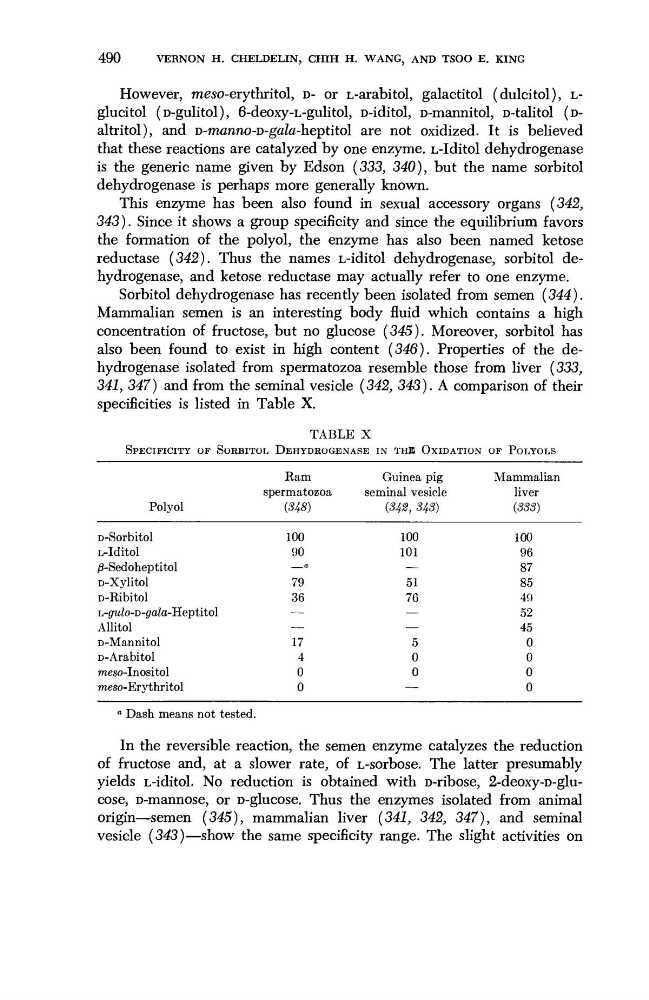
341, 347) and from the seminal vesicle (342, 343). A comparison of their
specificities is listed in Table X.
TABLE X
SPECIFICITY OF SORBITOL DEHYDROGENASE IN THE OXIDATION OF POLYOLS
Polyol
D-Sorbitol
L-Iditol
jff-Sedoheptitol
D-Xylitol
D-Ribitol
L-gulo-O-gala-Heptitol
Allitol
D-Mannitol
D-Arabitol
meso-Inositol
raeso-Erythritol
Ram
spermatozoa
(848)
100
90
a
79
36
—
—
17
4
0
0
Guinea pig
seminal vesicle
(342, 343)
100
101
—
51
76
—
—
5
0
0
—
Mamma]
liver
(333)
100
96
87
85
49
52
45
0
0
0
0
° Dash means not tested.
In the reversible reaction, the semen enzyme catalyzes the reduction
of fructose and, at a slower rate, of L-sorbose. The latter presumably
yields L-iditol. No reduction is obtained with D-ribose, 2-deoxy-D-glucose, D-mannose, or D-glucose. Thus the enzymes isolated from animal
origin—semen (345), mammalian liver (341, 342, 347), and seminal
vesicle (343)—show the same specificity range. The slight activities on
VERNON H. CHELDELIN, CHIH H. WANG, AND TSOO E. KING
However, raeso-erythritol, D- or L-arabitol, galactitol (dulcitol), Lglucitol (D-gulitol), 6-deoxy-L-gulitol, D-iditol, D-mannitol, D-talitol (Daltritol), and O-manno-O-gala-heptitol are not oxidized. It is believed
that these reactions are catalyzed by one enzyme. L-Iditol dehydrogenase
is the generic name given by Edson (333, 340), but the name sorbitol
dehydrogenase is perhaps more generally known.
This enzyme has been also found in sexual accessory organs (342,
343). Since it shows a group specificity and since the equilibrium favors
the formation of the polyol, the enzyme has also been named ketose
reductase (342). Thus the names L-iditol dehydrogenase, sorbitol dehydrogenase, and ketose reductase may actually refer to one enzyme.
Sorbitol dehydrogenase has recently been isolated from semen (344).
Mammalian semen is an interesting body fluid which contains a high
concentration of fructose, but no glucose (345). Moreover, sorbitol has
also been found to exist in high content (346). Properties of the dehydrogenase isolated from spermatozoa resemble those from liver (333,
341, 347) and from the seminal vesicle (342, 343). A comparison of their
specificities is listed in Table X.
TABLE X
SPECIFICITY OF SORBITOL DEHYDROGENASE IN THE OXIDATION OF POLYOLS
Polyol
D-Sorbitol
L-Iditol
jff-Sedoheptitol
D-Xylitol
D-Ribitol
L-gulo-O-gala-Heptitol
Allitol
D-Mannitol
D-Arabitol
meso-Inositol
raeso-Erythritol
Ram
spermatozoa
(848)
100
90
a
79
36
—
—
17
4
0
0
Guinea pig
seminal vesicle
(342, 343)
100
101
—
51
76
—
—
5
0
0
—
Mamma]
liver
(333)
100
96
87
85
49
52
45
0
0
0
0
° Dash means not tested.
In the reversible reaction, the semen enzyme catalyzes the reduction
of fructose and, at a slower rate, of L-sorbose. The latter presumably
yields L-iditol. No reduction is obtained with D-ribose, 2-deoxy-D-glucose, D-mannose, or D-glucose. Thus the enzymes isolated from animal
origin—semen (345), mammalian liver (341, 342, 347), and seminal
vesicle (343)—show the same specificity range. The slight activities on