

492
VERNON H. CHELDELIN, CHIH H. WANG, AND TSOO E. KING
An enzyme that has been isolated from seminal vesicles catalyzes
the following reaction:
Glucose + TPNH + H+ ^ Sorbitol + TPN+
Since the equilibrium position favors the formation of sorbitol the name
aldose reductase has been proposed (350, 351). This enzyme also occurs in the fetal blood of ungulates, placentas of certain mammals, fetal
liver, and other tissues. In addition to glucose, such compounds as D-glucosone, D-glucuronolactone, and D-glyceraldehyde are also active. This
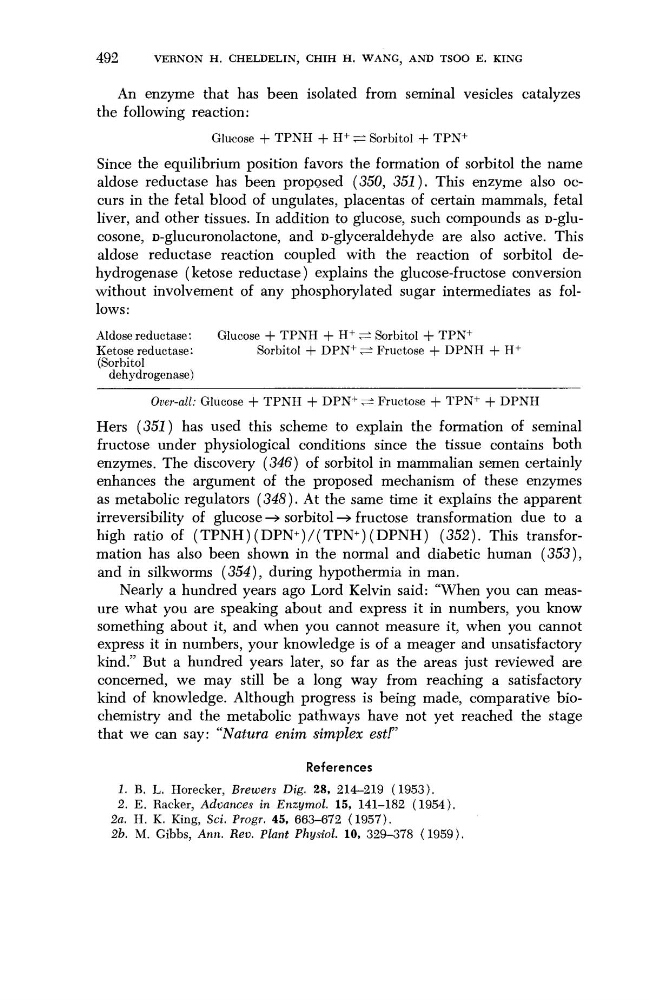
aldose reductase reaction coupled with the reaction of sorbitol dehydrogenase (ketose reductase) explains the glucose-fructose conversion
without involvement of any phosphorylated sugar intermediates as follows:
Aldose reductase:
Glucose + TPNH + H+ ^± Sorbitol + TPN+
Ketose reductase:
Sorbitol + DPN+ ^ Fructose + DPNH + H+
(Sorbitol
dehydrogenase)
Over-all: Glucose + TPNH + DPN+ ^± Fructose + TPN+ + DPNH
Hers (351) has used this scheme to explain the formation of seminal
fructose under physiological conditions since the tissue contains both
enzymes. The discovery (346) of sorbitol in mammalian semen certainly
enhances the argument of the proposed mechanism of these enzymes
as metabolic regulators (348). At the same time it explains the apparent
irreversibility of glucose —» sorbitol —> fructose transformation due to a
high ratio of (TPNH )(DPN
+ )/(TPN
+ )( DPNH) (352). This transformation has also been shown in the normal and diabetic human (353),
and in silkworms (354), during hypothermia in man.
Nearly a hundred years ago Lord Kelvin said: "When you can measure what you are speaking about and express it in numbers, you know
something about it, and when you cannot measure it, when you cannot
express it in numbers, your knowledge is of a meager and unsatisfactory
kind." But a hundred years later, so far as the areas just reviewed are
concerned, we may still be a long way from reaching a satisfactory
kind of knowledge. Although progress is being made, comparative biochemistry and the metabolic pathways have not yet reached the stage
that we can say: "Natura enim simplex est!"
References
1. B. L. Horecker, Brewers Dig. 28, 214-219 (1953).
2. E. Racker, Advances in Enzymol. 15, 141-182 (1954).
2a. H. K. King, Sei. Progr. 45, 663-672 (1957).
2b. M. Gibbs, Ann. Rev. Plant Physiol. 10, 329-378 (1959).
VERNON H. CHELDELIN, CHIH H. WANG, AND TSOO E. KING
An enzyme that has been isolated from seminal vesicles catalyzes
the following reaction:
Glucose + TPNH + H+ ^ Sorbitol + TPN+
Since the equilibrium position favors the formation of sorbitol the name
aldose reductase has been proposed (350, 351). This enzyme also occurs in the fetal blood of ungulates, placentas of certain mammals, fetal
liver, and other tissues. In addition to glucose, such compounds as D-glucosone, D-glucuronolactone, and D-glyceraldehyde are also active. This
aldose reductase reaction coupled with the reaction of sorbitol dehydrogenase (ketose reductase) explains the glucose-fructose conversion
without involvement of any phosphorylated sugar intermediates as follows:
Aldose reductase:
Glucose + TPNH + H+ ^± Sorbitol + TPN+
Ketose reductase:
Sorbitol + DPN+ ^ Fructose + DPNH + H+
(Sorbitol
dehydrogenase)
Over-all: Glucose + TPNH + DPN+ ^± Fructose + TPN+ + DPNH
Hers (351) has used this scheme to explain the formation of seminal
fructose under physiological conditions since the tissue contains both
enzymes. The discovery (346) of sorbitol in mammalian semen certainly
enhances the argument of the proposed mechanism of these enzymes
as metabolic regulators (348). At the same time it explains the apparent
irreversibility of glucose —» sorbitol —> fructose transformation due to a
high ratio of (TPNH )(DPN
+ )/(TPN
+ )( DPNH) (352). This transformation has also been shown in the normal and diabetic human (353),
and in silkworms (354), during hypothermia in man.
Nearly a hundred years ago Lord Kelvin said: "When you can measure what you are speaking about and express it in numbers, you know
something about it, and when you cannot measure it, when you cannot
express it in numbers, your knowledge is of a meager and unsatisfactory
kind." But a hundred years later, so far as the areas just reviewed are
concerned, we may still be a long way from reaching a satisfactory
kind of knowledge. Although progress is being made, comparative biochemistry and the metabolic pathways have not yet reached the stage
that we can say: "Natura enim simplex est!"
References
1. B. L. Horecker, Brewers Dig. 28, 214-219 (1953).
2. E. Racker, Advances in Enzymol. 15, 141-182 (1954).
2a. H. K. King, Sei. Progr. 45, 663-672 (1957).
2b. M. Gibbs, Ann. Rev. Plant Physiol. 10, 329-378 (1959).