

460
VERNON H. CHELDELIN, CHIH H. WANG, AND TSOO E. KING
substrate glucose is not playing a significant role. If necessary, the magnitude of the term G' T can be evaluated by an examination of the amount
of radioactivity incorporated into cellular constitutents in experiments
using glucose-3,4-C
14 , glucose-3-C
14 , or glucose-4-C
14 (data on C-4 of
glucose can be obtained indirectly from those in the glucose-3-C
14 and
glucose-3,4-C
14 experiments) as test substrates.
Unfortunately, similar corrections for the G 4 term cannot be readily
applied since a common intermediate, phosphogluconate, is shared by
both the pentose phosphate pathway and the Entner-Doudoroff pathway.
(2) With biological systems that catabolize substrate glucose only
to a limited extent, owing either to an extensive dilution of the labeled
substrate by endogeneous materials of a similar nature or the diffusion
of the labeled substrate into physiological compartments having relatively low metabolic activity, the exact amount of substrate glucose
actually engaged in catabolism would be rather difficult to determine
directly. This is indeed one of the major problems encountered when
one wishes to study pathway participation in such biological systems
as intact animals and intact plants.
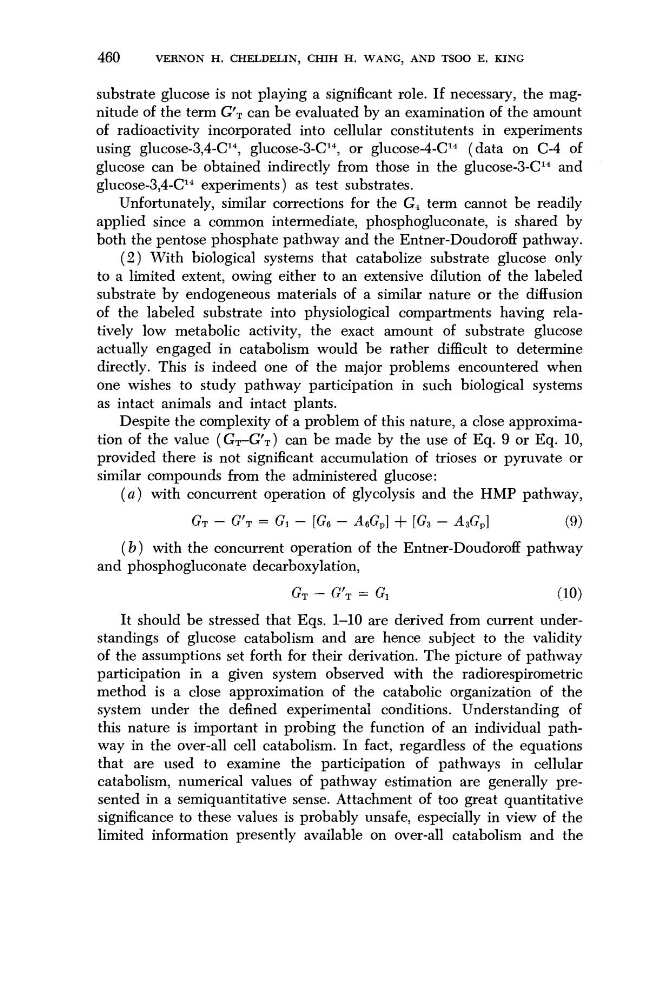
Despite the complexity of a problem of this nature, a close approximation of the value (G T -G' T ) can be made by the use of Eq. 9 or Eq. 10,
provided there is not significant accumulation of trioses or pyruvate or
similar compounds from the administered glucose:
(a) with concurrent operation of glycolysis and the HMP pathway,
G T - G'T = öi- [ (9)
(b) with the concurrent operation of the Entner-Doudoroff pathway
and phosphogluconate decarboxylation,
G T - G'T = G 1
(10)
It should be stressed that Eqs. 1-10 are derived from current understandings of glucose catabolism and are hence subject to the validity
of the assumptions set forth for their derivation. The picture of pathway
participation in a given system observed with the radiorespirometric
method is a close approximation of the catabolic organization of the
system under the defined experimental conditions. Understanding of
this nature is important in probing the function of an individual pathway in the over-all cell catabolism. In fact, regardless of the equations
that are used to examine the participation of pathways in cellular
catabolism, numerical values of pathway estimation are generally presented in a semiquantitative sense. Attachment of too great quantitative
significance to these values is probably unsafe, especially in view of the
limited information presently available on over-all catabolism and the
VERNON H. CHELDELIN, CHIH H. WANG, AND TSOO E. KING
substrate glucose is not playing a significant role. If necessary, the magnitude of the term G' T can be evaluated by an examination of the amount
of radioactivity incorporated into cellular constitutents in experiments
using glucose-3,4-C
14 , glucose-3-C
14 , or glucose-4-C
14 (data on C-4 of
glucose can be obtained indirectly from those in the glucose-3-C
14 and
glucose-3,4-C
14 experiments) as test substrates.
Unfortunately, similar corrections for the G 4 term cannot be readily
applied since a common intermediate, phosphogluconate, is shared by
both the pentose phosphate pathway and the Entner-Doudoroff pathway.
(2) With biological systems that catabolize substrate glucose only
to a limited extent, owing either to an extensive dilution of the labeled
substrate by endogeneous materials of a similar nature or the diffusion
of the labeled substrate into physiological compartments having relatively low metabolic activity, the exact amount of substrate glucose
actually engaged in catabolism would be rather difficult to determine
directly. This is indeed one of the major problems encountered when
one wishes to study pathway participation in such biological systems
as intact animals and intact plants.
Despite the complexity of a problem of this nature, a close approximation of the value (G T -G' T ) can be made by the use of Eq. 9 or Eq. 10,
provided there is not significant accumulation of trioses or pyruvate or
similar compounds from the administered glucose:
(a) with concurrent operation of glycolysis and the HMP pathway,
G T - G'T = öi- [ (9)
(b) with the concurrent operation of the Entner-Doudoroff pathway
and phosphogluconate decarboxylation,
G T - G'T = G 1
(10)
It should be stressed that Eqs. 1-10 are derived from current understandings of glucose catabolism and are hence subject to the validity
of the assumptions set forth for their derivation. The picture of pathway
participation in a given system observed with the radiorespirometric
method is a close approximation of the catabolic organization of the
system under the defined experimental conditions. Understanding of
this nature is important in probing the function of an individual pathway in the over-all cell catabolism. In fact, regardless of the equations
that are used to examine the participation of pathways in cellular
catabolism, numerical values of pathway estimation are generally presented in a semiquantitative sense. Attachment of too great quantitative
significance to these values is probably unsafe, especially in view of the
limited information presently available on over-all catabolism and the