

9. SACCHARIDES: ALTERNATE ROUTES OF METABOLISM
459
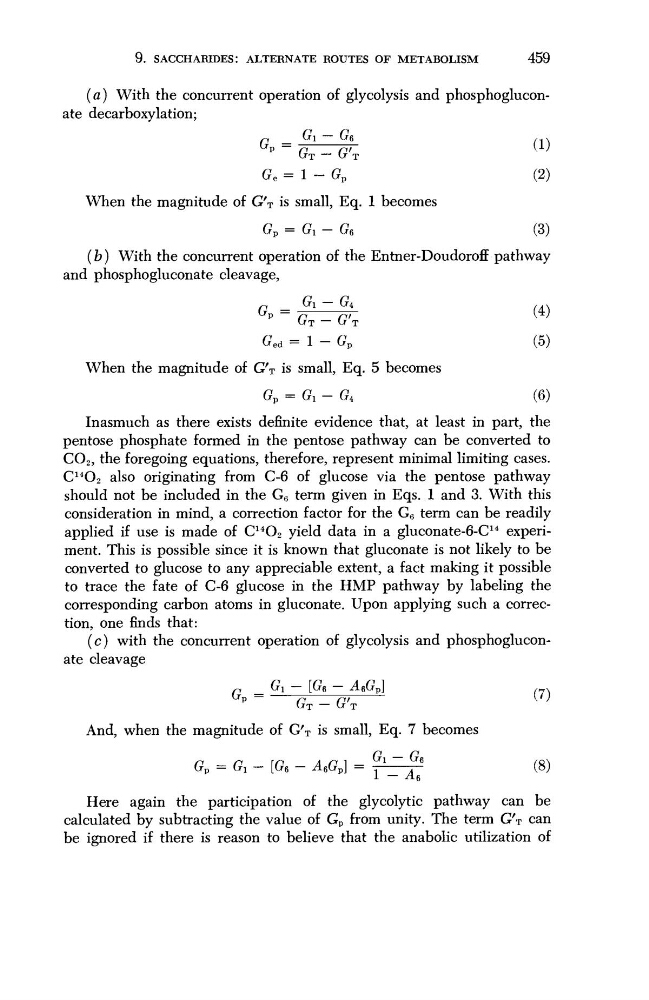
(a) With the concurrent operation of glycolysis and phosphogluconate decarboxylation;
^Ρ - r
7W
\\)
(JTT — yjr T
G e = 1 - G p
(2)
When the magnitude of G' T is small, Eq. 1 becomes
G p = Gi — (?6
(3)
(b) With the concurrent operation of the Entner-Doudoroff pathway
and phosphogluconate cleavage,
G» = ^
777(4)
(JTT — U" T
Ged = 1 — G v
(5)
When the magnitude of G' T is small, Eq. 5 becomes
G p = G 1 - (? 4
(6)
Inasmuch as there exists definite evidence that, at least in part, the
pentose phosphate formed in the pentose pathway can be converted to
C0 2 , the foregoing equations, therefore, represent minimal limiting cases.
C
14 0 2 also originating from C-6 of glucose via the pentose pathway
should not be included in the G 6 term given in Eqs. 1 and 3. With this
consideration in mind, a correction factor for the G 6 term can be readily
applied if use is made of C
14 0 2 yield data in a gluconate-6-C
14 experiment. This is possible since it is known that gluconate is not likely to be
converted to glucose to any appreciable extent, a fact making it possible
to trace the fate of C-6 glucose in the HMP pathway by labeling the
corresponding carbon atoms in gluconate. Upon applying such a correction, one finds that:
(c) with the concurrent operation of glycolysis and phosphogluconate cleavage
r — ^
1 ~ ^
6 ~ AeGp]
,„.
And, when the magnitude of G
r
T is small, Eq. 7 becomes
G P = G, - [G e - A 6 G V ] = ^Ξ-j;
(
8 )
Here again the participation of the glycolytic pathway can be
calculated by subtracting the value of G p from unity. The term G' T can
be ignored if there is reason to believe that the anabolic utilization of
459
(a) With the concurrent operation of glycolysis and phosphogluconate decarboxylation;
^Ρ - r
7W
\\)
(JTT — yjr T
G e = 1 - G p
(2)
When the magnitude of G' T is small, Eq. 1 becomes
G p = Gi — (?6
(3)
(b) With the concurrent operation of the Entner-Doudoroff pathway
and phosphogluconate cleavage,
G» = ^
777(4)
(JTT — U" T
Ged = 1 — G v
(5)
When the magnitude of G' T is small, Eq. 5 becomes
G p = G 1 - (? 4
(6)
Inasmuch as there exists definite evidence that, at least in part, the
pentose phosphate formed in the pentose pathway can be converted to
C0 2 , the foregoing equations, therefore, represent minimal limiting cases.
C
14 0 2 also originating from C-6 of glucose via the pentose pathway
should not be included in the G 6 term given in Eqs. 1 and 3. With this
consideration in mind, a correction factor for the G 6 term can be readily
applied if use is made of C
14 0 2 yield data in a gluconate-6-C
14 experiment. This is possible since it is known that gluconate is not likely to be
converted to glucose to any appreciable extent, a fact making it possible
to trace the fate of C-6 glucose in the HMP pathway by labeling the
corresponding carbon atoms in gluconate. Upon applying such a correction, one finds that:
(c) with the concurrent operation of glycolysis and phosphogluconate cleavage
r — ^
1 ~ ^
6 ~ AeGp]
,„.
And, when the magnitude of G
r
T is small, Eq. 7 becomes
G P = G, - [G e - A 6 G V ] = ^Ξ-j;
(
8 )
Here again the participation of the glycolytic pathway can be
calculated by subtracting the value of G p from unity. The term G' T can
be ignored if there is reason to believe that the anabolic utilization of