

454
VERNON H. CHELDELIN, CHIH H. WANG, AND TSOO E. KING
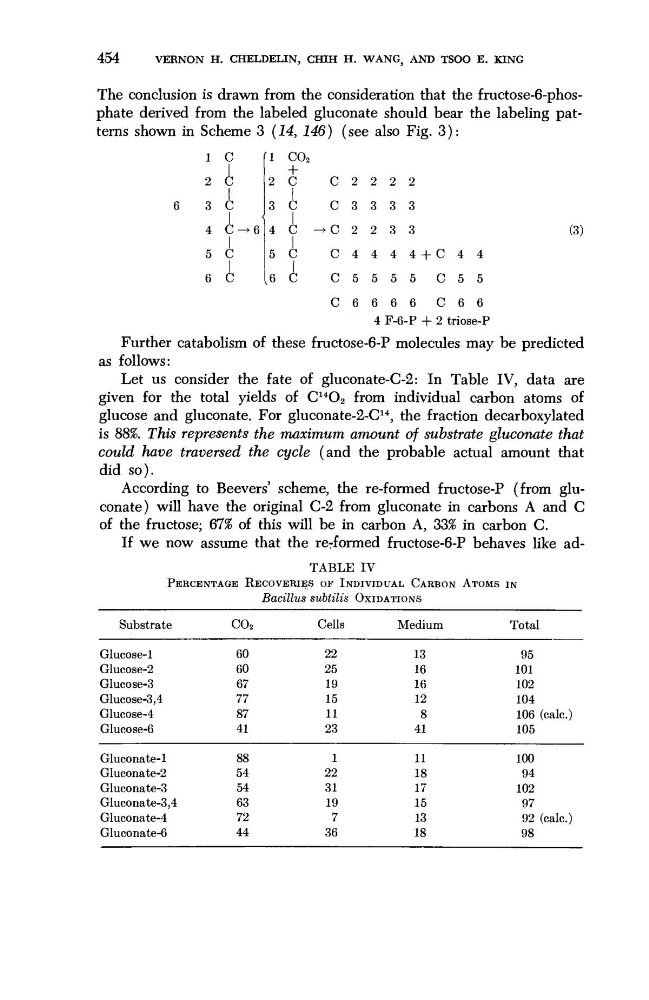
The conclusion is drawn from the consideration that the fructoses-phosphate derived from the labeled gluconate should bear the labeling patterns shown in Scheme 3 (14, 146) (see also Fig. 3):
1 C
, A
4 C-+6
5 A
1
1
6 C
r l C0 2
+
2 C
1
1
3 C
4 A
I 1
5 C
1 1
ß c
C 2 2 2 2
C 3 3 3 3
->C 2 2 3 3
C4444+C44
C5555
C55
C6666
C66
4 F-6-P + 2 triose-P
Further catabolism of these fructose-6-P molecules may be predicted
as follows:
Let us consider the fate of gluconate-C-2: In Table IV, data are
given for the total yields of C
14 0 2 from individual carbon atoms of
glucose and gluconate. For gluconate-2-C
14 , the fraction decarboxylated
is 88%. This represents the maximum amount of substrate gluconate that
could have traversed the cycle (and the probable actual amount that
did so).
According to Beevers' scheme, the re-formed fructose-P (from gluconate) will have the original C-2 from gluconate in carbons A and C
of the fructose; 67% of this will be in carbon A, 33% in carbon C.
If we now assume that the reformed fructose-6-P behaves like adTABLE IV
PERCENTAGE RECOVERIES OF INDIVIDUAL CARBON ATOMS IN
Bacillus subtilis OXIDATIONS
Substrate
Glucose-1
Glucose-2
Glucose-3
Glucose-3,4
Glucose-4
Glucose-6
Gluconate-1
Gluconate-2
Gluconate-3
Gluconate-3,4
Gluconate-4
Gluconate-6
C0 2
60
60
67
77
87
41
88
54
54
63
72
44
Cells
22
25
19
15
11
23
1
22
31
19
7
36
Medium
13
16
16
12
8
41
11
18
17
15
13
18
Total
95
101
102
104
106 (calc.)
105
100
94
102
97
92 (calc.)
98
VERNON H. CHELDELIN, CHIH H. WANG, AND TSOO E. KING
The conclusion is drawn from the consideration that the fructoses-phosphate derived from the labeled gluconate should bear the labeling patterns shown in Scheme 3 (14, 146) (see also Fig. 3):
1 C
, A
4 C-+6
5 A
1
1
6 C
r l C0 2
+
2 C
1
1
3 C
4 A
I 1
5 C
1 1
ß c
C 2 2 2 2
C 3 3 3 3
->C 2 2 3 3
C4444+C44
C5555
C55
C6666
C66
4 F-6-P + 2 triose-P
Further catabolism of these fructose-6-P molecules may be predicted
as follows:
Let us consider the fate of gluconate-C-2: In Table IV, data are
given for the total yields of C
14 0 2 from individual carbon atoms of
glucose and gluconate. For gluconate-2-C
14 , the fraction decarboxylated
is 88%. This represents the maximum amount of substrate gluconate that
could have traversed the cycle (and the probable actual amount that
did so).
According to Beevers' scheme, the re-formed fructose-P (from gluconate) will have the original C-2 from gluconate in carbons A and C
of the fructose; 67% of this will be in carbon A, 33% in carbon C.
If we now assume that the reformed fructose-6-P behaves like adTABLE IV
PERCENTAGE RECOVERIES OF INDIVIDUAL CARBON ATOMS IN
Bacillus subtilis OXIDATIONS
Substrate
Glucose-1
Glucose-2
Glucose-3
Glucose-3,4
Glucose-4
Glucose-6
Gluconate-1
Gluconate-2
Gluconate-3
Gluconate-3,4
Gluconate-4
Gluconate-6
C0 2
60
60
67
77
87
41
88
54
54
63
72
44
Cells
22
25
19
15
11
23
1
22
31
19
7
36
Medium
13
16
16
12
8
41
11
18
17
15
13
18
Total
95
101
102
104
106 (calc.)
105
100
94
102
97
92 (calc.)
98