

9. SACCHARIDES: ALTERNATE ROUTES OF METABOLISM
453
direct utilization of gluconate via glycolysis (upon direct conversion of
gluconate to glucose) seems impossible. This permits one to examine the
utilization of gluconate by way of F-6-P upon the completion of one turn
of the pentose cycle. It also permits the testing of one of the main
implications of the paper by Katz and Wood, since these authors appear
to imply that G-6-P traversing the pentose cycle can be further catabolized only via a repeated mechanism of the same nature, without side
steps into other pathways via a common intermediate.
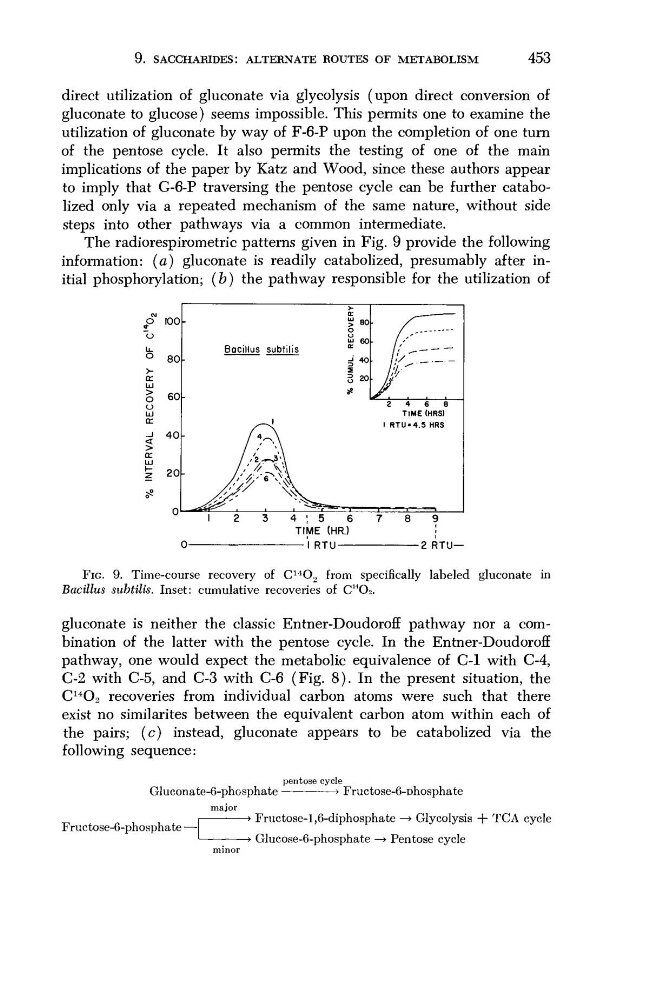
The radiorespirometric patterns given in Fig. 9 provide the following
information: (a) gluconate is readily catabolized, presumably after initial phosphorylation; (b) the pathway responsible for the utilization of
> o o
< >
lOOh
2 RTUFIG. 9. Time-course recovery of C
14 0 2 from specifically labeled gluconate in
Bacillus subtilis. Inset: cumulative recoveries of C
14 0 2 .
gluconate is neither the classic Entner-Doudoroff pathway nor a combination of the latter with the pentose cycle. In the Entner-Doudoroff
pathway, one would expect the metabolic equivalence of C-l with C-4,
C-2 with C-5, and C-3 with C-6 (Fig. 8). In the present situation, the
C
14 0 2 recoveries from individual carbon atoms were such that there
exist no similarites between the equivalent carbon atom within each of
the pairs; (c) instead, gluconate appears to be catabolized via the
following sequence:
pentose cycle
Gluconate-6-phosphate
> Fructose-6-phosphate
Fructose-6-phosphate -
-> Fructose-l,6-diphosphate —► Glycolysis + TCA cycle
-> Glucose-6-phosphate —> Pentose cycle
453
direct utilization of gluconate via glycolysis (upon direct conversion of
gluconate to glucose) seems impossible. This permits one to examine the
utilization of gluconate by way of F-6-P upon the completion of one turn
of the pentose cycle. It also permits the testing of one of the main
implications of the paper by Katz and Wood, since these authors appear
to imply that G-6-P traversing the pentose cycle can be further catabolized only via a repeated mechanism of the same nature, without side
steps into other pathways via a common intermediate.
The radiorespirometric patterns given in Fig. 9 provide the following
information: (a) gluconate is readily catabolized, presumably after initial phosphorylation; (b) the pathway responsible for the utilization of
> o o
< >
lOOh
2 RTUFIG. 9. Time-course recovery of C
14 0 2 from specifically labeled gluconate in
Bacillus subtilis. Inset: cumulative recoveries of C
14 0 2 .
gluconate is neither the classic Entner-Doudoroff pathway nor a combination of the latter with the pentose cycle. In the Entner-Doudoroff
pathway, one would expect the metabolic equivalence of C-l with C-4,
C-2 with C-5, and C-3 with C-6 (Fig. 8). In the present situation, the
C
14 0 2 recoveries from individual carbon atoms were such that there
exist no similarites between the equivalent carbon atom within each of
the pairs; (c) instead, gluconate appears to be catabolized via the
following sequence:
pentose cycle
Gluconate-6-phosphate
> Fructose-6-phosphate
Fructose-6-phosphate -
-> Fructose-l,6-diphosphate —► Glycolysis + TCA cycle
-> Glucose-6-phosphate —> Pentose cycle