

9. SACCHARIDES: ALTERNATE ROUTES OF METABOLISM
431
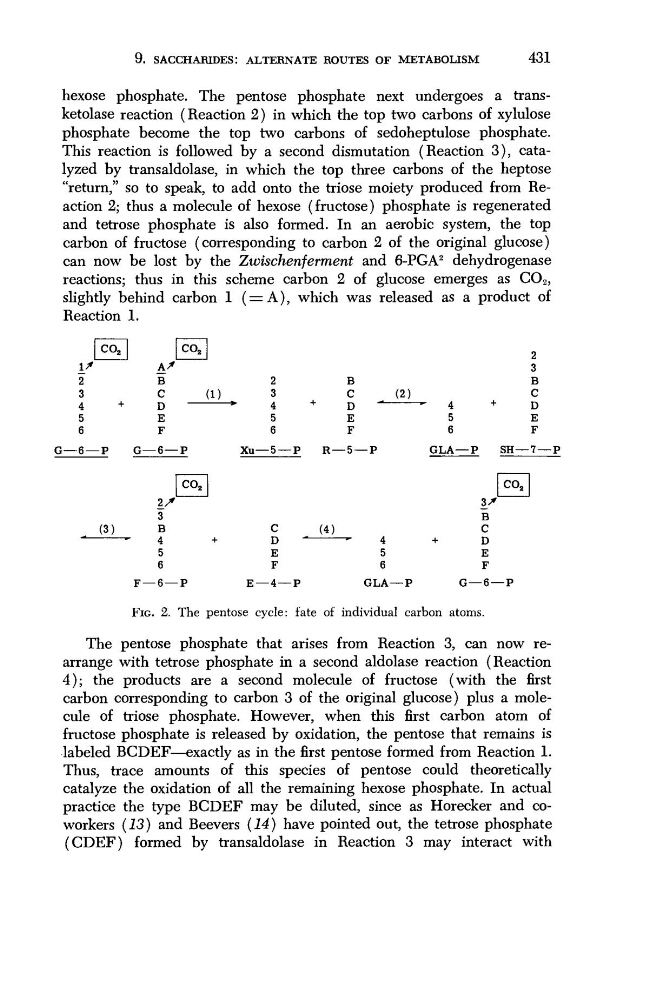
hexose phosphate. The pentose phosphate next undergoes a transketolase reaction (Reaction 2) in which the top two carbons of xylulose
phosphate become the top two carbons of sedoheptulose phosphate.
This reaction is followed by a second dismutation (Reaction 3), catalyzed by transaldolase, in which the top three carbons of the heptose
"return," so to speak, to add onto the triose moiety produced from Reaction 2; thus a molecule of hexose (fructose) phosphate is regenerated
and tetrose phosphate is also formed. In an aerobic system, the top
carbon of fructose (corresponding to carbon 2 of the original glucose)
can now be lost by the Zwischenferment and 6-PGA
2 dehydrogenase
reactions; thus in this scheme carbon 2 of glucose emerges as C0 2 ,
slightly behind carbon 1 (=A), which was released as a product of
Reaction 1.
1/
co 2
2
3
4
+
5
6
G—6—-P
(3)
A^
co 2
B
C
D
(1)
E
F
G—6—
2S
vP
co 2
3
B
4
+
5
6
2
3
~*
4
5
6
Xu—5C
D
E
F
ζΣ
B
C
+
D
E
F
R—5(4)
"
-P
4
5
6
(2)
2
3
B
-r
4
+
C
D
5
E
6
F
GLA—P
3S
SH—
co 2
7 —
B
C
+
D
E
F
-P
GLAG—6
FIG. 2. The pentose cycle: fate of individual carbon atoms.
The pentose phosphate that arises from Reaction 3, can now rearrange with tetrose phosphate in a second aldolase reaction (Reaction
4); the products are a second molecule of fructose (with the first
carbon corresponding to carbon 3 of the original glucose) plus a molecule of triose phosphate. However, when this first carbon atom of
fructose phosphate is released by oxidation, the pentose that remains is
labeled BCDEF—exactly as in the first pentose formed from Reaction 1.
Thus, trace amounts of this species of pentose could theoretically
catalyze the oxidation of all the remaining hexose phosphate. In actual
practice the type BCDEF may be diluted, since as Horecker and coworkers (13) and Beevers (14) have pointed out, the tetrose phosphate
(CDEF) formed by transaldolase in Reaction 3 may interact with
431
hexose phosphate. The pentose phosphate next undergoes a transketolase reaction (Reaction 2) in which the top two carbons of xylulose
phosphate become the top two carbons of sedoheptulose phosphate.
This reaction is followed by a second dismutation (Reaction 3), catalyzed by transaldolase, in which the top three carbons of the heptose
"return," so to speak, to add onto the triose moiety produced from Reaction 2; thus a molecule of hexose (fructose) phosphate is regenerated
and tetrose phosphate is also formed. In an aerobic system, the top
carbon of fructose (corresponding to carbon 2 of the original glucose)
can now be lost by the Zwischenferment and 6-PGA
2 dehydrogenase
reactions; thus in this scheme carbon 2 of glucose emerges as C0 2 ,
slightly behind carbon 1 (=A), which was released as a product of
Reaction 1.
1/
co 2
2
3
4
+
5
6
G—6—-P
(3)
A^
co 2
B
C
D
(1)
E
F
G—6—
2S
vP
co 2
3
B
4
+
5
6
2
3
~*
4
5
6
Xu—5C
D
E
F
ζΣ
B
C
+
D
E
F
R—5(4)
"
-P
4
5
6
(2)
2
3
B
-r
4
+
C
D
5
E
6
F
GLA—P
3S
SH—
co 2
7 —
B
C
+
D
E
F
-P
GLAG—6
FIG. 2. The pentose cycle: fate of individual carbon atoms.
The pentose phosphate that arises from Reaction 3, can now rearrange with tetrose phosphate in a second aldolase reaction (Reaction
4); the products are a second molecule of fructose (with the first
carbon corresponding to carbon 3 of the original glucose) plus a molecule of triose phosphate. However, when this first carbon atom of
fructose phosphate is released by oxidation, the pentose that remains is
labeled BCDEF—exactly as in the first pentose formed from Reaction 1.
Thus, trace amounts of this species of pentose could theoretically
catalyze the oxidation of all the remaining hexose phosphate. In actual
practice the type BCDEF may be diluted, since as Horecker and coworkers (13) and Beevers (14) have pointed out, the tetrose phosphate
(CDEF) formed by transaldolase in Reaction 3 may interact with