

430
VERNON H. CHELDELIN, CHIH H. WANG, AND TSOO E. KING
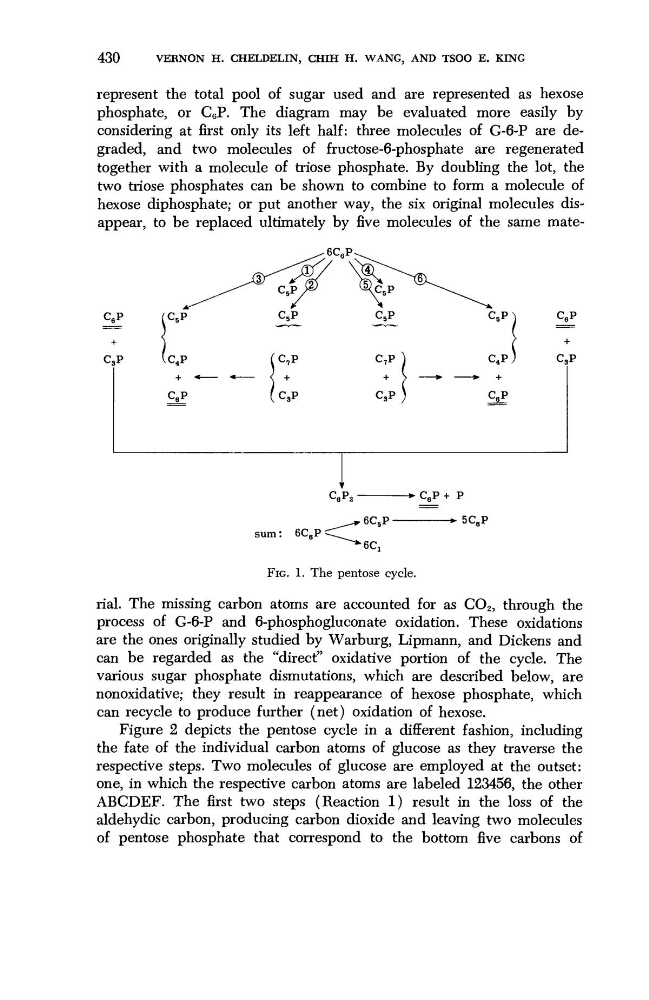
represent the total pool of sugar used and are represented as hexose
phosphate, or C 6 P. The diagram may be evaluated more easily by
considering at first only its left half: three molecules of G-6-P are degraded, and two molecules of fructose-6-phosphate are regenerated
together with a molecule of triose phosphate. By doubling the lot, the
two triose phosphates can be shown to combine to form a molecule of
hexose diphosphate; or put another way, the six original molecules disappear, to be replaced ultimately by five molecules of the same mate6C ß P.
C R P
iC B P
C S P
C 5 P
C,P
C«P
C,P
lC 4 P
+
C e P
C 7 P
+
C a P
C 7 P
C 3 P
C 4 P,
+
C e P
C 3 P
sum: 6C e P
FIG. 1. The pentose cycle.
rial. The missing carbon atoms are accounted for as C0 2 , through the
process of G-6-P and 6-phosphogluconate oxidation. These oxidations
are the ones originally studied by Warburg, Lipmann, and Dickens and
can be regarded as the "direct" oxidative portion of the cycle. The
various sugar phosphate dismutations, which are described below, are
nonoxidative; they result in reappearance of hexose phosphate, which
can recycle to produce further (net) oxidation of hexose.
Figure 2 depicts the pentose cycle in a different fashion, including
the fate of the individual carbon atoms of glucose as they traverse the
respective steps. Two molecules of glucose are employed at the outset:
one, in which the respective carbon atoms are labeled 123456, the other
ABCDEF. The first two steps (Reaction 1) result in the loss of the
aldehydic carbon, producing carbon dioxide and leaving two molecules
of pentose phosphate that correspond to the bottom five carbons of
VERNON H. CHELDELIN, CHIH H. WANG, AND TSOO E. KING
represent the total pool of sugar used and are represented as hexose
phosphate, or C 6 P. The diagram may be evaluated more easily by
considering at first only its left half: three molecules of G-6-P are degraded, and two molecules of fructose-6-phosphate are regenerated
together with a molecule of triose phosphate. By doubling the lot, the
two triose phosphates can be shown to combine to form a molecule of
hexose diphosphate; or put another way, the six original molecules disappear, to be replaced ultimately by five molecules of the same mate6C ß P.
C R P
iC B P
C S P
C 5 P
C,P
C«P
C,P
lC 4 P
+
C e P
C 7 P
+
C a P
C 7 P
C 3 P
C 4 P,
+
C e P
C 3 P
sum: 6C e P
FIG. 1. The pentose cycle.
rial. The missing carbon atoms are accounted for as C0 2 , through the
process of G-6-P and 6-phosphogluconate oxidation. These oxidations
are the ones originally studied by Warburg, Lipmann, and Dickens and
can be regarded as the "direct" oxidative portion of the cycle. The
various sugar phosphate dismutations, which are described below, are
nonoxidative; they result in reappearance of hexose phosphate, which
can recycle to produce further (net) oxidation of hexose.
Figure 2 depicts the pentose cycle in a different fashion, including
the fate of the individual carbon atoms of glucose as they traverse the
respective steps. Two molecules of glucose are employed at the outset:
one, in which the respective carbon atoms are labeled 123456, the other
ABCDEF. The first two steps (Reaction 1) result in the loss of the
aldehydic carbon, producing carbon dioxide and leaving two molecules
of pentose phosphate that correspond to the bottom five carbons of