

432
VERNON H. CHELDELIN, CHIH H. WANG, AND TSOO E. KING
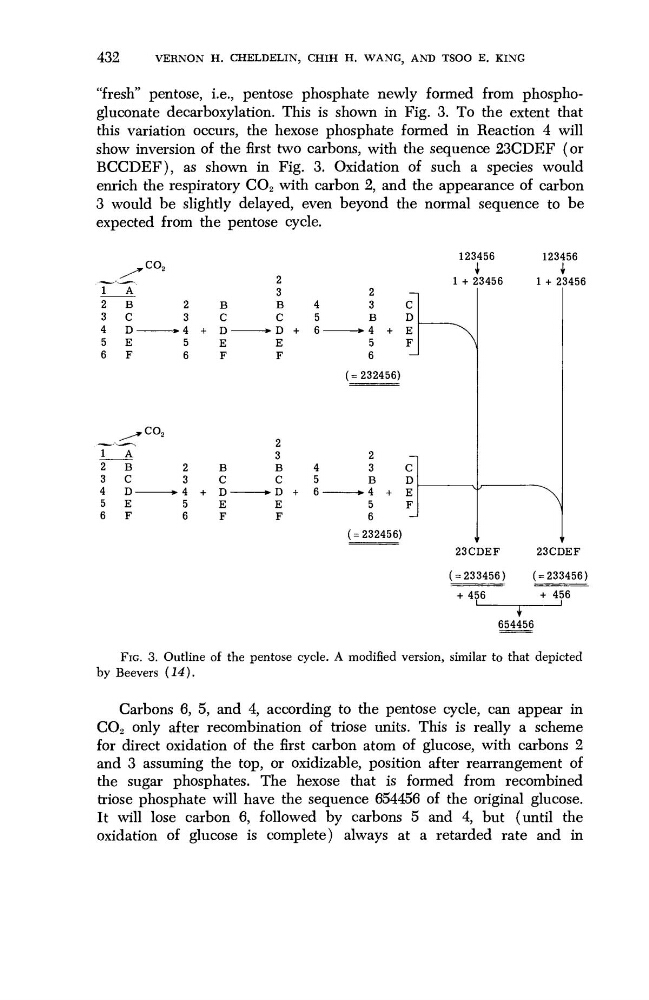
"fresh" pentose, i.e., pentose phosphate newly formed from phosphogluconate decarboxylation. This is shown in Fig. 3. To the extent that
this variation occurs, the hexose phosphate formed in Reaction 4 will
show inversion of the first two carbons, with the sequence 23CDEF (or
BCCDEF), as shown in Fig. 3. Oxidation of such a species would
enrich the respiratory C0 2 with carbon 2, and the appearance of carbon
3 would be slightly delayed, even beyond the normal sequence to be
expected from the pentose cycle.
1
2
3
4
5
6
2
3
4
5
6
A
B
C
DE
F
B
C
DE
F
r co 2
,co 2
2
3
-*4 +
5
6
2
3
■* 4
+
5
6
B
C
D
E
F
B
C
D
E
F
2
3
B
C
> D +
E
F
2
3
B
C
>Ό +
E
F
4
5
6 —
4
5
6 —
2
-
3
C
B
D
► 4 + E
5
F
6
-
(=232456)
2
-η
3
C
B
D
► 4 + E
5
F
6
J
( = 232456)
123
1 + 2
Λ
Vs
^
456
3456
J
'
23CDEF
( = 233456)
+ 4E )6
123<
1 + 2
~N
156
3456
T
23CDEF
( = 233456)
+ 4£
1
654456
)6
FIG. 3. Outline of the pentose cycle. A modified version, similar to that depicted
by Beevers (14).
Carbons 6, 5, and 4, according to the pentose cycle, can appear in
C0 2 only after recombination of triose units. This is really a scheme
for direct oxidation of the first carbon atom of glucose, with carbons 2
and 3 assuming the top, or oxidizable, position after rearrangement of
the sugar phosphates. The hexose that is formed from recombined
triose phosphate will have the sequence 654456 of the original glucose.
It will lose carbon 6, followed by carbons 5 and 4, but (until the
oxidation of glucose is complete) always at a retarded rate and in
VERNON H. CHELDELIN, CHIH H. WANG, AND TSOO E. KING
"fresh" pentose, i.e., pentose phosphate newly formed from phosphogluconate decarboxylation. This is shown in Fig. 3. To the extent that
this variation occurs, the hexose phosphate formed in Reaction 4 will
show inversion of the first two carbons, with the sequence 23CDEF (or
BCCDEF), as shown in Fig. 3. Oxidation of such a species would
enrich the respiratory C0 2 with carbon 2, and the appearance of carbon
3 would be slightly delayed, even beyond the normal sequence to be
expected from the pentose cycle.
1
2
3
4
5
6
2
3
4
5
6
A
B
C
DE
F
B
C
DE
F
r co 2
,co 2
2
3
-*4 +
5
6
2
3
■* 4
+
5
6
B
C
D
E
F
B
C
D
E
F
2
3
B
C
> D +
E
F
2
3
B
C
>Ό +
E
F
4
5
6 —
4
5
6 —
2
-
3
C
B
D
► 4 + E
5
F
6
-
(=232456)
2
-η
3
C
B
D
► 4 + E
5
F
6
J
( = 232456)
123
1 + 2
Λ
Vs
^
456
3456
J
'
23CDEF
( = 233456)
+ 4E )6
123<
1 + 2
~N
156
3456
T
23CDEF
( = 233456)
+ 4£
1
654456
)6
FIG. 3. Outline of the pentose cycle. A modified version, similar to that depicted
by Beevers (14).
Carbons 6, 5, and 4, according to the pentose cycle, can appear in
C0 2 only after recombination of triose units. This is really a scheme
for direct oxidation of the first carbon atom of glucose, with carbons 2
and 3 assuming the top, or oxidizable, position after rearrangement of
the sugar phosphates. The hexose that is formed from recombined
triose phosphate will have the sequence 654456 of the original glucose.
It will lose carbon 6, followed by carbons 5 and 4, but (until the
oxidation of glucose is complete) always at a retarded rate and in