

8. POLYSACCHARIDASES
399
cellulase yielded at least eight components with C x activity and different electrophoretic mobilities (264). Paper and column chromatography
(265, 266), as well as paper electrophoresis (267), have equally shown
the occurrence of several components.
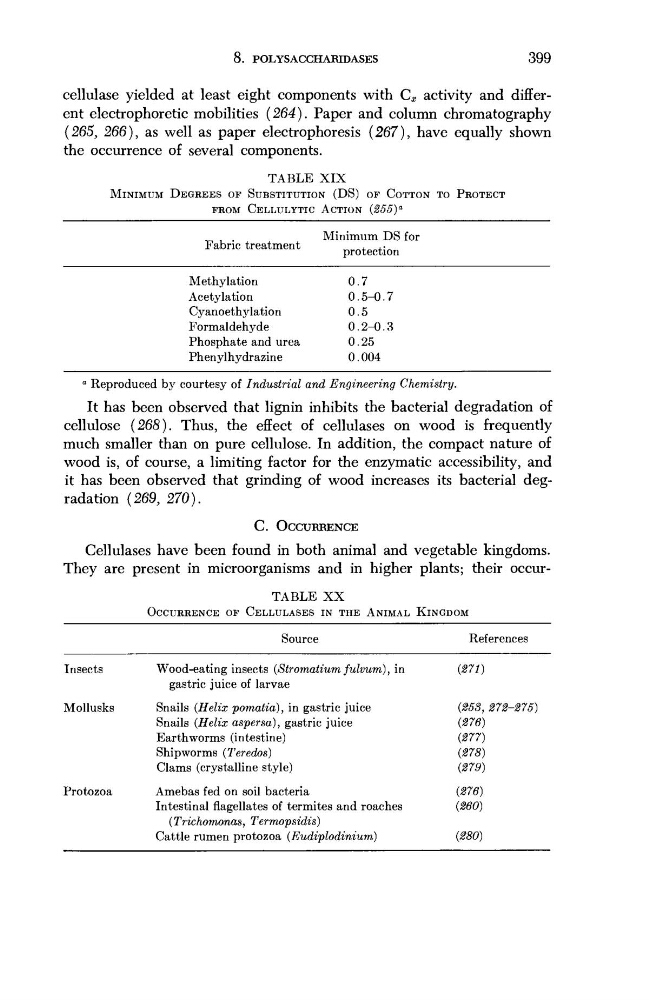
TABLE XIX
MINIMUM DEGREES OF SUBSTITUTION (DS) OF COTTON TO PROTECT
FROM CELLULYTIC ACTION (255)
a
Fabric treatment
Methylation
Acetylation
Cyanoethylation
Formaldehyde
Phosphate and urea
Phenylhydrazine
Minimum DS for
protection
0.7
0.5-0.7
0.5
0.2-0.3
0.25
0.004
α Reproduced by courtesy of Industrial and Engineering Chemistry.
It has been observed that lignin inhibits the bacterial degradation of
cellulose (268). Thus, the effect of cellulases on wood is frequently
much smaller than on pure cellulose. In addition, the compact nature of
wood is, of course, a limiting factor for the enzymatic accessibility, and
it has been observed that grinding of wood increases its bacterial degradation (269, 270).
C. OCCURRENCE
Cellulases have been found in both animal and vegetable kingdoms.
They are present in microorganisms and in higher plants; their occurTABLE XX
OCCURRENCE OF CELLULASES IN THE ANIMAL KINGDOM
Source
References
Insects
Wood-eating insects (Stromatium fulvum), in
(271)
gastric juice of larvae
Mollusks
Snails (Helix pomatia), in gastric juice
Snails (Helix aspersa), gastric juice
(276)
Earthworms (intestine)
(277)
Ship worms (Teredos)
(278)
Clams (crystalline style)
Protozoa
Amebas fed on soil bacteria
Intestinal flagellates of termites and roaches
(Trichomonas,
Termopsidis)
Cattle rumen protozoa (Eudiplodinium)
(280)
(253, 272-275)
(279)
(276)
(260)
399
cellulase yielded at least eight components with C x activity and different electrophoretic mobilities (264). Paper and column chromatography
(265, 266), as well as paper electrophoresis (267), have equally shown
the occurrence of several components.
TABLE XIX
MINIMUM DEGREES OF SUBSTITUTION (DS) OF COTTON TO PROTECT
FROM CELLULYTIC ACTION (255)
a
Fabric treatment
Methylation
Acetylation
Cyanoethylation
Formaldehyde
Phosphate and urea
Phenylhydrazine
Minimum DS for
protection
0.7
0.5-0.7
0.5
0.2-0.3
0.25
0.004
α Reproduced by courtesy of Industrial and Engineering Chemistry.
It has been observed that lignin inhibits the bacterial degradation of
cellulose (268). Thus, the effect of cellulases on wood is frequently
much smaller than on pure cellulose. In addition, the compact nature of
wood is, of course, a limiting factor for the enzymatic accessibility, and
it has been observed that grinding of wood increases its bacterial degradation (269, 270).
C. OCCURRENCE
Cellulases have been found in both animal and vegetable kingdoms.
They are present in microorganisms and in higher plants; their occurTABLE XX
OCCURRENCE OF CELLULASES IN THE ANIMAL KINGDOM
Source
References
Insects
Wood-eating insects (Stromatium fulvum), in
(271)
gastric juice of larvae
Mollusks
Snails (Helix pomatia), in gastric juice
Snails (Helix aspersa), gastric juice
(276)
Earthworms (intestine)
(277)
Ship worms (Teredos)
(278)
Clams (crystalline style)
Protozoa
Amebas fed on soil bacteria
Intestinal flagellates of termites and roaches
(Trichomonas,
Termopsidis)
Cattle rumen protozoa (Eudiplodinium)
(280)
(253, 272-275)
(279)
(276)
(260)