

400
PETER BERNFELD
rence in animals appears to be limited to mollusks and protozoa. The
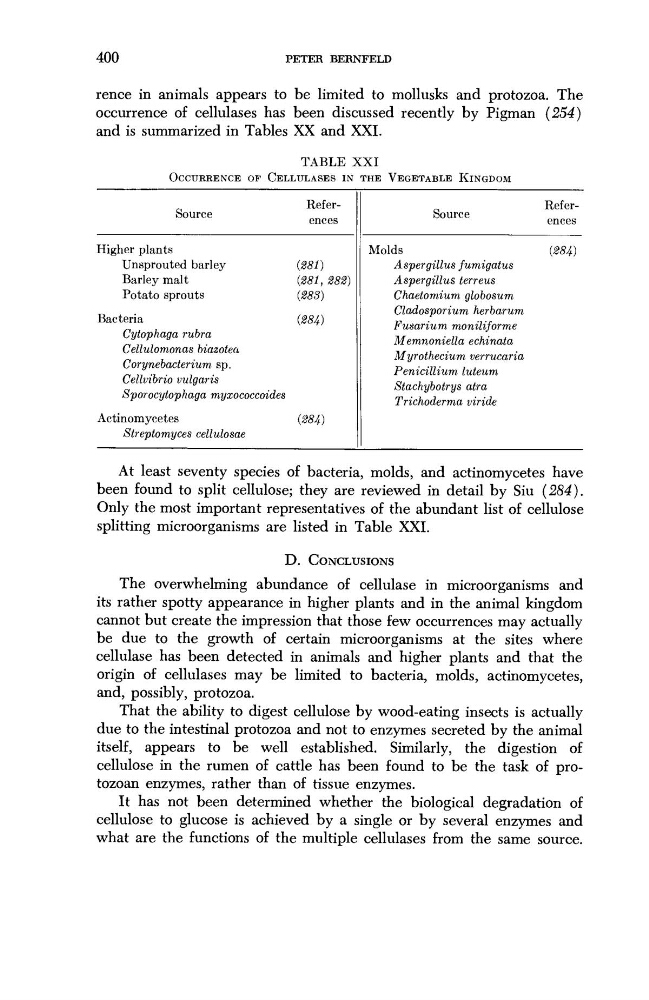
occurrence of cellulases has been discussed recently by Pigman (254)
and is summarized in Tables XX and XXI.
TABLE XXI
OCCURRENCE OF CELLULASES IN THE VEGETABLE KINGDOM
ReferSource
ences
Higher plants
Unsprouted barley
{281)
Barley malt
{281, 282)
Potato sprouts
{283)
Bacteria
{284)
Cytophaga rubra
Cellulomonas biazotea
Corynebacterium sp.
Cellvibrio vulgaris
Sporocytophaga myxococcoides
Actinomycetes
{284)
Streptomyces cellulosae
_.
Referoource
ences
Molds
{284)
Aspergillus
fumigatus
Aspergillus terreus
Chaetomium globosum
Cladosporium herbarum
Fusarium
moniliforme
Memnoniella echinata
Myrothecium verrucaria
Penicillium luteum
Stachybotrys atra
Trichoderma viride
At least seventy species of bacteria, molds, and actinomycetes have
been found to split cellulose; they are reviewed in detail by Siu (284),
Only the most important representatives of the abundant list of cellulose
splitting microorganisms are listed in Table XXI.
D. CONCLUSIONS
The overwhelming abundance of cellulase in microorganisms and
its rather spotty appearance in higher plants and in the animal kingdom
cannot but create the impression that those few occurrences may actually
be due to the growth of certain microorganisms at the sites where
cellulase has been detected in animals and higher plants and that the
origin of cellulases may be limited to bacteria, molds, actinomycetes,
and, possibly, protozoa.
That the ability to digest cellulose by wood-eating insects is actually
due to the intestinal protozoa and not to enzymes secreted by the animal
itself, appears to be well established. Similarly, the digestion of
cellulose in the rumen of cattle has been found to be the task of protozoan enzymes, rather than of tissue enzymes.
It has not been determined whether the biological degradation of
cellulose to glucose is achieved by a single or by several enzymes and
what are the functions of the multiple cellulases from the same source.
PETER BERNFELD
rence in animals appears to be limited to mollusks and protozoa. The
occurrence of cellulases has been discussed recently by Pigman (254)
and is summarized in Tables XX and XXI.
TABLE XXI
OCCURRENCE OF CELLULASES IN THE VEGETABLE KINGDOM
ReferSource
ences
Higher plants
Unsprouted barley
{281)
Barley malt
{281, 282)
Potato sprouts
{283)
Bacteria
{284)
Cytophaga rubra
Cellulomonas biazotea
Corynebacterium sp.
Cellvibrio vulgaris
Sporocytophaga myxococcoides
Actinomycetes
{284)
Streptomyces cellulosae
_.
Referoource
ences
Molds
{284)
Aspergillus
fumigatus
Aspergillus terreus
Chaetomium globosum
Cladosporium herbarum
Fusarium
moniliforme
Memnoniella echinata
Myrothecium verrucaria
Penicillium luteum
Stachybotrys atra
Trichoderma viride
At least seventy species of bacteria, molds, and actinomycetes have
been found to split cellulose; they are reviewed in detail by Siu (284),
Only the most important representatives of the abundant list of cellulose
splitting microorganisms are listed in Table XXI.
D. CONCLUSIONS
The overwhelming abundance of cellulase in microorganisms and
its rather spotty appearance in higher plants and in the animal kingdom
cannot but create the impression that those few occurrences may actually
be due to the growth of certain microorganisms at the sites where
cellulase has been detected in animals and higher plants and that the
origin of cellulases may be limited to bacteria, molds, actinomycetes,
and, possibly, protozoa.
That the ability to digest cellulose by wood-eating insects is actually
due to the intestinal protozoa and not to enzymes secreted by the animal
itself, appears to be well established. Similarly, the digestion of
cellulose in the rumen of cattle has been found to be the task of protozoan enzymes, rather than of tissue enzymes.
It has not been determined whether the biological degradation of
cellulose to glucose is achieved by a single or by several enzymes and
what are the functions of the multiple cellulases from the same source.