

398
PETER BERNFELD
saccharides up to the hexaose, and possibly even of higher degrees of
polymerization.
Festenstein (262) has shown that cellobiase from sheep-rumen microorganisms is completely inhibited by 2.5 mM gluconolaetone, whereas
the cellulase from the same origin, acting on carboxymethylcellulose, is
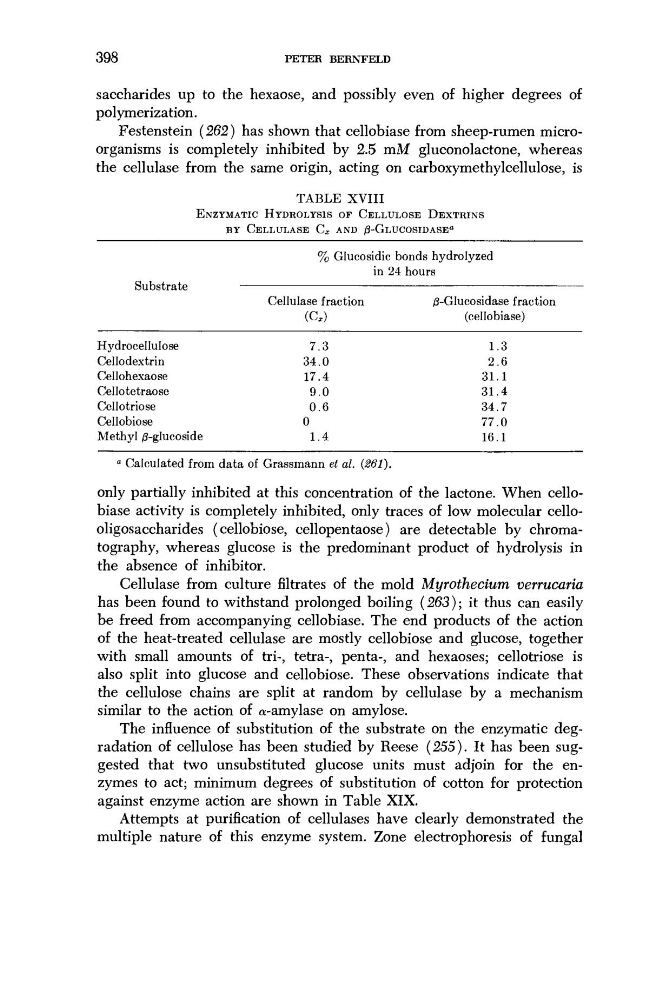
TABLE XVIII
ENZYMATIC HYDROLYSIS OF CELLULOSE DEXTRINS
BY CELLULASE CX AND /S-GLUCOSIDASE
0
Substrate
Hydrocellulose
Cellodextrin
Cellohexaose
Cellotetraose
Cellotriose
Cellobiose
Methyl /3-glucoside
% Glucosidic bonds hydrolyzed
Cellulase fraction
(CJ
7.3
34.0
17.4
9.0
0.6
0
1.4
in 24 hours
ß-Glucosidase fraction
(cellobiase)
1.3
2.6
31.1
31.4
34.7
77.0
16.1
° Calculated from data of Grassmann et al. (261).
only partially inhibited at this concentration of the lactone. When cellobiase activity is completely inhibited, only traces of low molecular cellooligosaccharides (cellobiose, cellopentaose) are detectable by chromatography, whereas glucose is the predominant product of hydrolysis in
the absence of inhibitor.
Cellulase from culture filtrates of the mold Myrothecium verrucaria
has been found to withstand prolonged boiling (263); it thus can easily
be freed from accompanying cellobiase. The end products of the action
of the heat-treated cellulase are mostly cellobiose and glucose, together
with small amounts of tri-, tetra-, penta-, and hexaoses; cellotriose is
also split into glucose and cellobiose. These observations indicate that
the cellulose chains are split at random by cellulase by a mechanism
similar to the action of α-amylase on amylose.
The influence of substitution of the substrate on the enzymatic degradation of cellulose has been studied by Reese (255). It has been suggested that two unsubstituted glucose units must adjoin for the enzymes to act; minimum degrees of substitution of cotton for protection
against enzyme action are shown in Table XIX.
Attempts at purification of cellulases have clearly demonstrated the
multiple nature of this enzyme system. Zone electrophoresis of fungal
PETER BERNFELD
saccharides up to the hexaose, and possibly even of higher degrees of
polymerization.
Festenstein (262) has shown that cellobiase from sheep-rumen microorganisms is completely inhibited by 2.5 mM gluconolaetone, whereas
the cellulase from the same origin, acting on carboxymethylcellulose, is
TABLE XVIII
ENZYMATIC HYDROLYSIS OF CELLULOSE DEXTRINS
BY CELLULASE CX AND /S-GLUCOSIDASE
0
Substrate
Hydrocellulose
Cellodextrin
Cellohexaose
Cellotetraose
Cellotriose
Cellobiose
Methyl /3-glucoside
% Glucosidic bonds hydrolyzed
Cellulase fraction
(CJ
7.3
34.0
17.4
9.0
0.6
0
1.4
in 24 hours
ß-Glucosidase fraction
(cellobiase)
1.3
2.6
31.1
31.4
34.7
77.0
16.1
° Calculated from data of Grassmann et al. (261).
only partially inhibited at this concentration of the lactone. When cellobiase activity is completely inhibited, only traces of low molecular cellooligosaccharides (cellobiose, cellopentaose) are detectable by chromatography, whereas glucose is the predominant product of hydrolysis in
the absence of inhibitor.
Cellulase from culture filtrates of the mold Myrothecium verrucaria
has been found to withstand prolonged boiling (263); it thus can easily
be freed from accompanying cellobiase. The end products of the action
of the heat-treated cellulase are mostly cellobiose and glucose, together
with small amounts of tri-, tetra-, penta-, and hexaoses; cellotriose is
also split into glucose and cellobiose. These observations indicate that
the cellulose chains are split at random by cellulase by a mechanism
similar to the action of α-amylase on amylose.
The influence of substitution of the substrate on the enzymatic degradation of cellulose has been studied by Reese (255). It has been suggested that two unsubstituted glucose units must adjoin for the enzymes to act; minimum degrees of substitution of cotton for protection
against enzyme action are shown in Table XIX.
Attempts at purification of cellulases have clearly demonstrated the
multiple nature of this enzyme system. Zone electrophoresis of fungal