

316
D. J. BELL
The combined amino sugars are usually found with their amino group
acylated. In a few instances, e.g., in heparin the amino group is believed
to be substituted by sulfate to give a sulfamidate
I
H—C—NH · S0 2 0"
I
which bears some analogy to the phosphoamidate structure characteristic of the phosphagens
I
—C—NH · PO · 0 2
2 ~
I
The free sugars, being primary amines, are readily protonated and
form stable salts (e.g., Reaction 10).
H
H
€<^
+H 3 0
+ ^^>C<^
+ H 2 0
(10)
NH 2
NH 3
+
They are therefore considerably more resistant to decomposition by
mineral acid than are the ordinary, nonamino sugars. Thus, many of
the chemical reactions used to detect carbohydrates which depend on
a transformation of monosaccharides into derivatives of furfural or
4-oxopentanoic acid (levulinic acid) and other substances (53), through
the action of strong mineral acid, fail with the 2-aminohexoses (53a).*
In recent years several interesting amino sugars, in addition to
(LXV) and (LXVI), and including N-methyl derivatives, have been
shown to occur in glycosidic combination as components of certain
antibiotics. Streptothrycin and streptolin-B have been found to contain
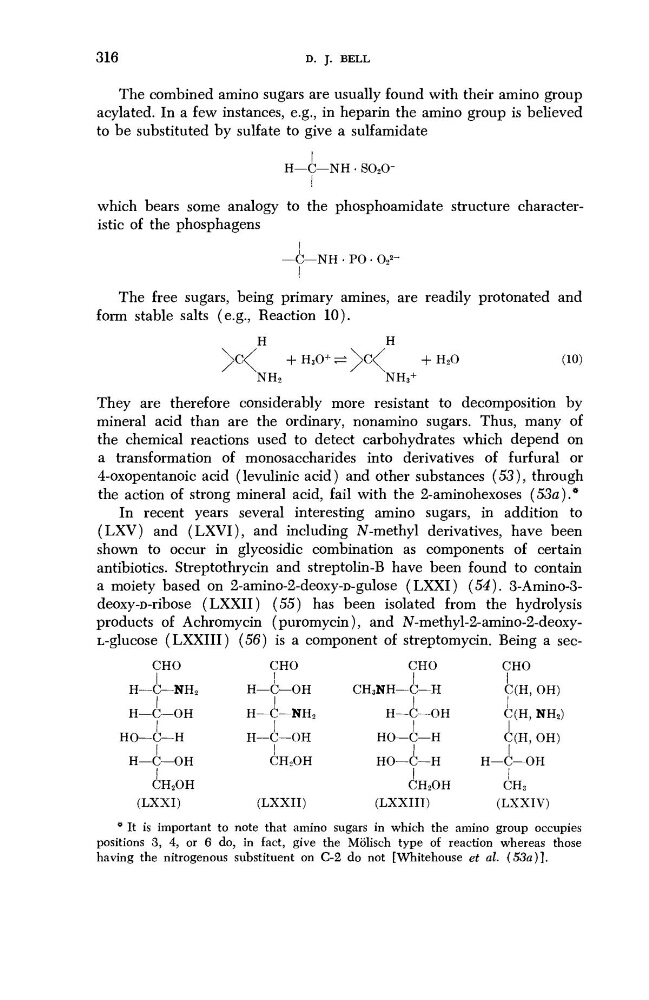
a moiety based on 2-amino-2-deoxy-D-gulose (LXXI) (54). 3-Amino-3deoxy-D-ribose (LXXII) (55) has been isolated from the hydrolysis
products of Achromycin (puromycin), and IV-methyl-2-amino-2-deoxyL-glucose (LXXIII) (56) is a component of streptomycin. Being a secCHO
CHO
CHO
CHO
I
!
II
H—C—NH 2
H—C—OH
CH 3 NH—C—H
C(H, OH)
II
II
H—C—OH
H—C—NH 2
H—C—OH
C(H, NH 2 )
II
II
HO—C—H
H—C—OH
HO—C—H
C(H, OH)
I
!
I
I
H—C—OH
CH2OH
HO—C—H
H—C—OH
I
I
I
CH 2 OH
CH 2 OH
CH 3
(LXXI)
(LXXII)
(LXXIII)
(LXXIV)
* It is important to note that amino sugars in which the amino group occupies
positions 3, 4, or 6 do, in fact, give the Molisch type of reaction whereas those
having the nitrogenous substituent on C-2 do not [Whitehouse et al. (53a)].
D. J. BELL
The combined amino sugars are usually found with their amino group
acylated. In a few instances, e.g., in heparin the amino group is believed
to be substituted by sulfate to give a sulfamidate
I
H—C—NH · S0 2 0"
I
which bears some analogy to the phosphoamidate structure characteristic of the phosphagens
I
—C—NH · PO · 0 2
2 ~
I
The free sugars, being primary amines, are readily protonated and
form stable salts (e.g., Reaction 10).
H
H
€<^
+H 3 0
+ ^^>C<^
+ H 2 0
(10)
NH 2
NH 3
+
They are therefore considerably more resistant to decomposition by
mineral acid than are the ordinary, nonamino sugars. Thus, many of
the chemical reactions used to detect carbohydrates which depend on
a transformation of monosaccharides into derivatives of furfural or
4-oxopentanoic acid (levulinic acid) and other substances (53), through
the action of strong mineral acid, fail with the 2-aminohexoses (53a).*
In recent years several interesting amino sugars, in addition to
(LXV) and (LXVI), and including N-methyl derivatives, have been
shown to occur in glycosidic combination as components of certain
antibiotics. Streptothrycin and streptolin-B have been found to contain
a moiety based on 2-amino-2-deoxy-D-gulose (LXXI) (54). 3-Amino-3deoxy-D-ribose (LXXII) (55) has been isolated from the hydrolysis
products of Achromycin (puromycin), and IV-methyl-2-amino-2-deoxyL-glucose (LXXIII) (56) is a component of streptomycin. Being a secCHO
CHO
CHO
CHO
I
!
II
H—C—NH 2
H—C—OH
CH 3 NH—C—H
C(H, OH)
II
II
H—C—OH
H—C—NH 2
H—C—OH
C(H, NH 2 )
II
II
HO—C—H
H—C—OH
HO—C—H
C(H, OH)
I
!
I
I
H—C—OH
CH2OH
HO—C—H
H—C—OH
I
I
I
CH 2 OH
CH 2 OH
CH 3
(LXXI)
(LXXII)
(LXXIII)
(LXXIV)
* It is important to note that amino sugars in which the amino group occupies
positions 3, 4, or 6 do, in fact, give the Molisch type of reaction whereas those
having the nitrogenous substituent on C-2 do not [Whitehouse et al. (53a)].