

7. MONOSACCHARIDES AND OLIGOSACCHARIDES
317
1
CHO
CHO
CHO
2
j
C(H, OH)
j
CH 2
j
C(H, OH)
1
3
j
C[H, N(CH 3 ) 2 ]
j
C[H, N(CH 3 ) 2 ]
C[H, N(CH 3 ) 2 ]
j
4
j
CH 2
CH 2
CH 2
5
J
C(H, OH)
j
C(H, OH)
j
C(H, OH)
6
j
CH 3
CH 3
CH 2 OH
(LXXV)
(LXXVI)
(LXXVII)
A sugar, probably a stereoisomer of (LXXV) named mycaminose (61),
has been obtained from Magnamycin (carbomycin); rhodosamine
(LXXVI) (62), from rhodomycin, appears to be the 2-deoxy analog of
the structure (LXXV). Amicetin yields amosamine (63) which is the
3,4-dideoxy analog of (LXXV), namely (LXXVII).
A newcomer to the sugar series is 2,6-diamino-2,6-dideoxy-D-glucose
(LXXVIII) which is isolated, primarily as a disaccharide with D-ribose
(XII), from neomycins Β and C (64). (LXXVIII) has been named
neosamine C. From Bacillus subtilis Β also, a diaminohexose has been
obtained (65).
CHO
1
H—C—NH 2
1
HO—C—Η
1
Η—C—OH
H—C—OH
1
CH 2 NH 2
(LXXVIII)
V. Occurrence of Some Commoner Monosaccharides,
Free and in Glycosidic Combination
In the free state, with the exception of D-glucose, and to a lesser
extent, D-fructose, monosaccharides are normally found only in trace
ondary amine, this sugar is more strongly basic than glucosamine itself.
Mycosamine (LXXIV) (57), from Magnamycin, is a D-sugar; at the
time of writing the stereochemistry has not been fully established.
Several dimethylamino sugars have been isolated from hydrolyzed
antibiotics, but at the time of writing the stereochemistry of these substances also has not been fully established. Picromycin, several erythromycins, methmycin, neomethmycin, and novomycin all yield a dimethylamino-3,4,6-trideoxyhexose, variously termed picrocine (58), desosamine
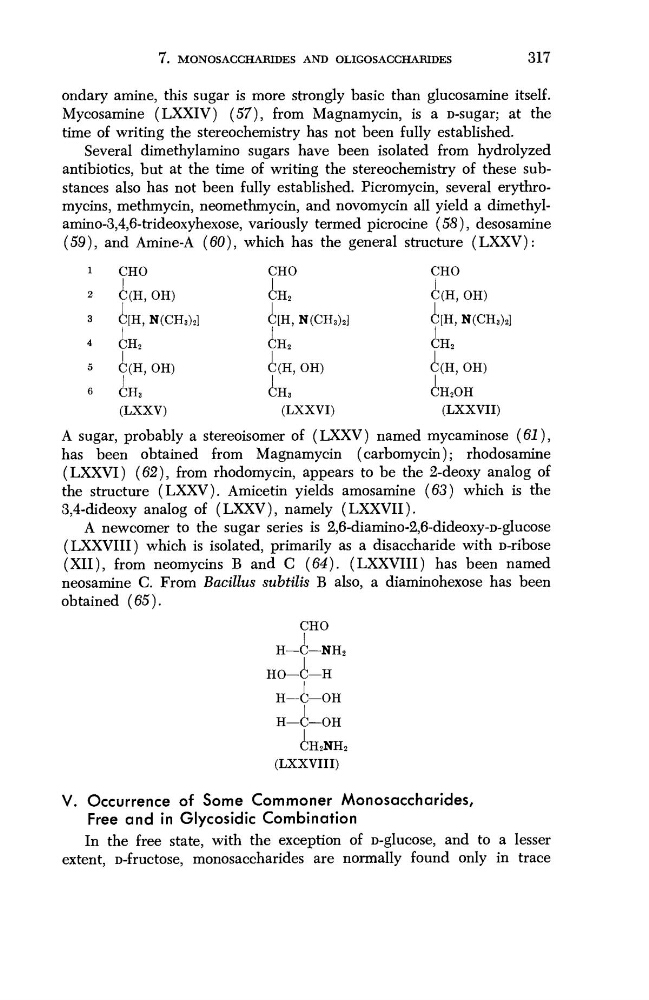
(59), and Amine-A (60), which has the general structure (LXXV):
317
1
CHO
CHO
CHO
2
j
C(H, OH)
j
CH 2
j
C(H, OH)
1
3
j
C[H, N(CH 3 ) 2 ]
j
C[H, N(CH 3 ) 2 ]
C[H, N(CH 3 ) 2 ]
j
4
j
CH 2
CH 2
CH 2
5
J
C(H, OH)
j
C(H, OH)
j
C(H, OH)
6
j
CH 3
CH 3
CH 2 OH
(LXXV)
(LXXVI)
(LXXVII)
A sugar, probably a stereoisomer of (LXXV) named mycaminose (61),
has been obtained from Magnamycin (carbomycin); rhodosamine
(LXXVI) (62), from rhodomycin, appears to be the 2-deoxy analog of
the structure (LXXV). Amicetin yields amosamine (63) which is the
3,4-dideoxy analog of (LXXV), namely (LXXVII).
A newcomer to the sugar series is 2,6-diamino-2,6-dideoxy-D-glucose
(LXXVIII) which is isolated, primarily as a disaccharide with D-ribose
(XII), from neomycins Β and C (64). (LXXVIII) has been named
neosamine C. From Bacillus subtilis Β also, a diaminohexose has been
obtained (65).
CHO
1
H—C—NH 2
1
HO—C—Η
1
Η—C—OH
H—C—OH
1
CH 2 NH 2
(LXXVIII)
V. Occurrence of Some Commoner Monosaccharides,
Free and in Glycosidic Combination
In the free state, with the exception of D-glucose, and to a lesser
extent, D-fructose, monosaccharides are normally found only in trace
ondary amine, this sugar is more strongly basic than glucosamine itself.
Mycosamine (LXXIV) (57), from Magnamycin, is a D-sugar; at the
time of writing the stereochemistry has not been fully established.
Several dimethylamino sugars have been isolated from hydrolyzed
antibiotics, but at the time of writing the stereochemistry of these substances also has not been fully established. Picromycin, several erythromycins, methmycin, neomethmycin, and novomycin all yield a dimethylamino-3,4,6-trideoxyhexose, variously termed picrocine (58), desosamine
(59), and Amine-A (60), which has the general structure (LXXV):